
Salem-area buried heating oil tanks are concentrated in homes built between approximately 1925 and 1985, with the densest inventory in the older capitol-district neighborhoods (Highland, Englewood, Court-Chemeketa, Yew Park, Grant Neighborhood) and the mid-century South Salem and Cherry Park-era homes. After about 1985 the Salem-area new-home heating standard shifted to natural gas via NW Natural, so post-1985 homes rarely have buried tanks unless explicitly added.
A substantial share of pre-1985 single-family homes in Marion and Polk counties has either a current buried tank or evidence of one removed before DEQ database tracking began. That is why a buyer's lender flagging "unknown UST" is so common in Salem real estate; the uncertainty itself drives most decommissioning work in the market.
For the broader decommissioning context once a tank is confirmed, see the Salem oil tank removal pillar. For real-estate transaction specifics, see selling or buying a Salem home with an oil tank.
// In this guide
- 01Why Salem's housing stock concentrates buried tanks
- 02Visual indicators in Salem yards and basements
- 03Searching the DEQ Heating Oil Tank database for your Salem address
- 04Tank-locate scanning options in the Salem market
- 05What happens once you confirm a Salem tank
- 06Salem neighborhood-by-neighborhood patterns
Why Salem's housing stock concentrates buried tanks
Heating oil was the default residential fuel in Western Oregon from approximately 1925 to 1965, peaking in market share around 1955. NW Natural's gas distribution network expanded into Salem neighborhoods on an extended timeline through the late 1970s; many homes converted to gas as the service became available locally but left the original buried oil tank in place because excavation was disruptive and (at the time) not required.
- 01Pre-1925 Salem homes (West Salem core, Yew Park, parts of Highland). Some still have buried tanks from later retrofits (homes added oil heat circa 1930-1945 when the original wood-stove or radiator-coal system was replaced).
- 021925-1955 Salem homes (Highland, Englewood, Court-Chemeketa, Grant Neighborhood). Highest concentration of original-installed buried tanks. Most are 275-gallon or 500-gallon single-wall steel, installed in the front or side yard 24 to 36 inches deep.
- 031955-1975 Salem homes (South Salem, Lansing, Sunnyside, Cherry Park, North Salem expansion). Mid-century forced-air homes; tanks often installed in the side yard. Some properties converted to gas in the 1970s but left tanks in place. Driveway extensions added in the 1965-1975 era frequently sit on top of original tanks.
- 041975-1985 Salem homes (Lansing/Sunnyside late phase, West Salem post-WWII expansion). Lower concentration; gas was increasingly the new-build standard. Some properties retain original tanks; many were intentionally removed at sale before the current DEQ database tracking became standard.
- 05Post-1985 Salem homes. Rare. New-construction natural gas was the standard. A buried tank on a post-1985 home is almost always an explicit retrofit (homeowner installation) rather than an original feature.
Visual indicators in Salem yards and basements
Five visual indicators reliably suggest a buried tank exists or once existed. Most Salem-area properties showing one or more of these have either a current tank or evidence of one removed before tracking.
- 01Vent pipe protruding from a flower bed, side yard, or driveway edge. A 1.5-to-2-inch black or galvanised pipe sticking 12 to 36 inches out of the ground, usually near the foundation. Designed to vent fuel-delivery vapour during fill-ups. If the pipe is capped or cut flush with the ground, the tank may have been intentionally abandoned without proper decommissioning.
- 02Fill cap or pipe stub at ground level. A 4-inch round cap (sometimes with a Buckeye, Morrison, or OPW manufacturer mark) flush with the ground or covered by a flower bed. The fill cap is where the heating oil delivery truck connected its hose. Look in the driveway apron area, side yard within 6 feet of the house, or front yard.
- 03Old patched section of driveway concrete or asphalt. A rectangular patch roughly 3 by 8 feet, sometimes with a different color or texture from the surrounding driveway. This often indicates where a tank was either originally installed or later excavated.
- 04Capped supply line stub at the basement or crawlspace foundation wall. A 0.5-inch or 0.75-inch copper or steel line emerging from the foundation, terminating in a cap. This was the fuel supply line from the buried tank to the original oil furnace. If the line is capped at the wall, the tank may still be in the ground.
- 05Old basement oil-furnace footprint or flue patch. A 4 by 4 foot bare concrete area in the basement where an oil furnace once sat, with a patched chimney or flue penetration above. The furnace may be long gone but the tank that fed it may not be.
Tip
A buried tank can exist with zero visible surface indicators if previous owners removed the vent pipe, capped the supply line below grade, and resurfaced the driveway. The absence of visual indicators does not rule out a tank — it just means a geophysical scan is needed to confirm one way or the other.
Searching the DEQ Heating Oil Tank database for your Salem address
Oregon DEQ maintains a public, address-searchable Heating Oil Tank database covering decommissionings filed since approximately 1995. A property with a filed Decommissioning Report appears with status detail; a property without a filed Report does not appear, which (importantly) does not mean a tank does not exist.
- 01Database access. DEQ publishes the Heating Oil Tank database online through the DEQ public records portal. Search by street address (exact match) or partial address; results show closure status, date, and tank type.
- 02Status interpretations. "Decommissioned" = tank confirmed removed, soil samples clean, Report filed. "Abandonment in Place" = tank left in ground, properly filled, soil samples clean, Report filed. "Cleanup" = release was confirmed and soil contamination was addressed; ends with "No Further Action" letter when complete. "Open" = release confirmed but cleanup not closed yet (rare on residential).
- 03Absence of a record means three different things. One, the property had a tank that was removed before tracking began (pre-1995 removals often have only paper records or none). Two, the property has an unremoved buried tank that no one has filed paperwork on. Three, the property never had a tank. The database cannot distinguish these three; only field investigation can.
- 04Marion and Polk County records. Same statewide database; Marion and Polk addresses both appear if records exist. Some pre-1995 removals were filed only with the City of Salem Building Services Division as a permit application; the City retains some historical paper records that DEQ does not.
Note
The DEQ database is the first place to check, not the last. A "no record" result against a 1940s Highland bungalow is informative only weakly — most pre-1985 Salem homes that show no record have either had a tank removed pre-1995 (paper only) or still have one undocumented. Plan to scan if the home is pre-1985 and shows no database record.
Tank-locate scanning options in the Salem market
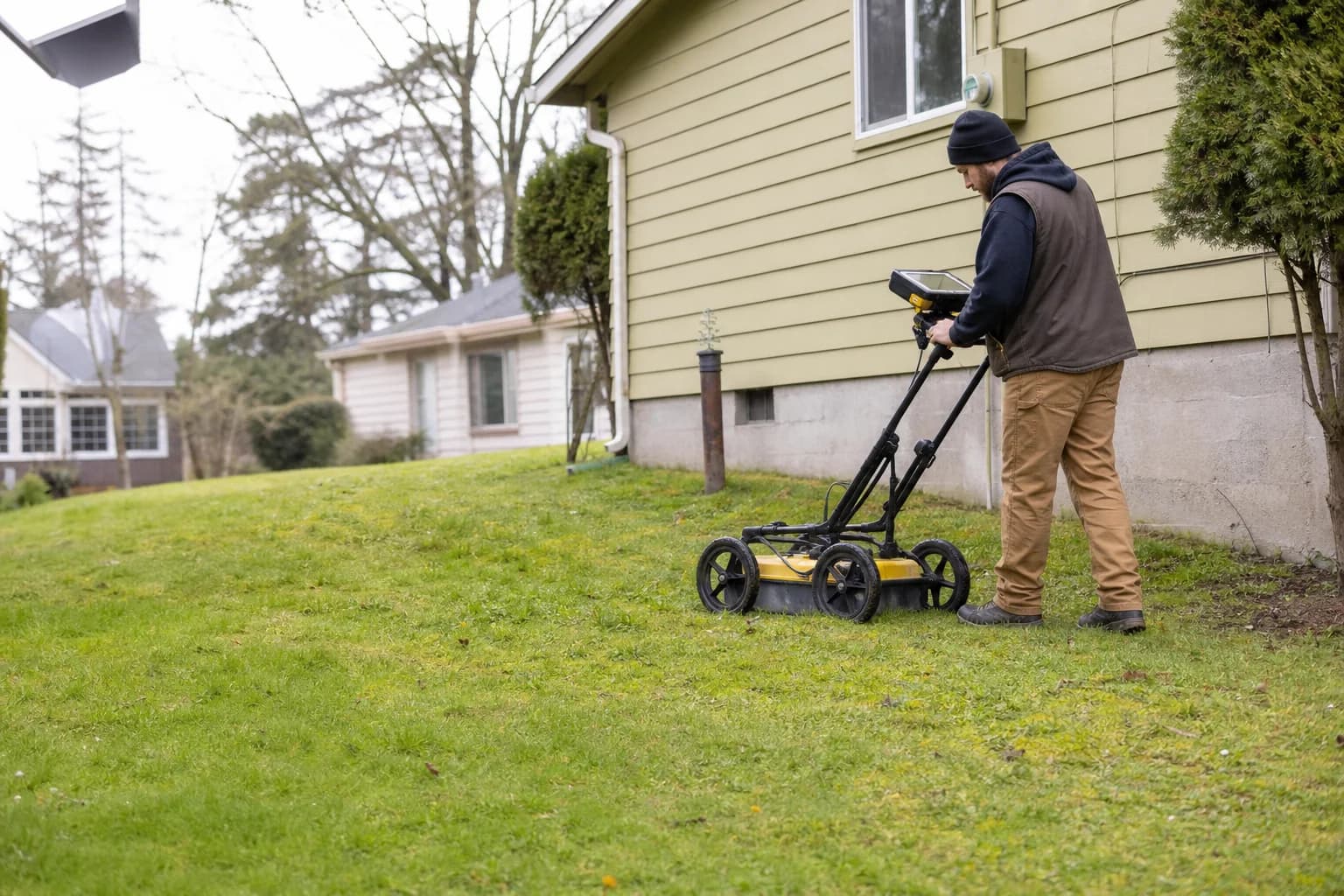
When visual indicators are inconclusive and the DEQ database returns no record, a geophysical scan confirms presence or absence of a buried tank. Three technologies, three price points; most Salem providers use one or two.
- 01Ground-penetrating radar (GPR), $350 to $600 per scan. Most common Salem-area tank-locate technology. A handheld unit pushes electromagnetic pulses into the soil and reads the reflected signal; metal objects (steel tanks, water lines, gas lines) reflect strongly. Works well in Salem's silty clay loam to depths of 5 to 8 feet, which covers the typical 24-to-36-inch tank-installation depth comfortably. Lab turnaround: same-day field report; sometimes a follow-up written report.
- 02Magnetometer, $250 to $450 per scan. Reads magnetic anomalies in the subsurface. Cheaper than GPR but more prone to false positives from buried rebar, gas lines, or property-line iron stakes. Works as a screening tool for properties where the goal is "is there definitely or definitely not a tank"; less useful for precisely locating a confirmed tank.
- 03Soil probe, $200 to $400 per scan. Manual or hand-driven probe pushed at suspected locations to physically contact buried metal. Cheapest option; only works when the suspected location is known reasonably precisely. Often used as a confirmation step after GPR has flagged a likely location.
- 04Combined scan-and-decommission packages. Many Salem licensed DEQ HOT providers offer GPR scanning bundled into a decommissioning quote; if the scan finds a tank, the decommissioning proceeds and the scan cost folds into the total. If no tank is found, the scan is invoiced standalone. This structure benefits the homeowner because the scan cost is at risk for the provider if no tank exists.
What happens once you confirm a Salem tank
Confirmation creates an obligation under OAR 340-177: an out-of-service tank must be decommissioned. The decision tree from confirmation is straightforward:
- 01Tank is in active use. Continue using it. There is no Oregon law requiring active-use tanks to be removed. The decommissioning obligation kicks in when the tank goes out of service (gas conversion, heat pump conversion, fuel-source change).
- 02Tank is out of service or being taken out of service. Decommissioning is required. Choose removal vs abandonment in place based on the structural realities of your lot. See the abandon vs remove decision pillar.
- 03Buyer's lender required confirmation. Get the Decommissioning Report filed before close. The DEQ database entry following the Report is what closes the loop with the lender.
- 04Tank locate found a tank you did not know existed. Treat it as out-of-service unless you connect a furnace to it. Most "found" tanks have been out of service for decades and need decommissioning under the current rules.
- 05You found visual indicators but the scan was negative. Sometimes the indicators (vent pipe, fill cap) date from a tank that was removed pre-1995 without a filed Decommissioning Report. This is the case where the DEQ "no record" combined with a negative scan creates a documentation gap: the work was done but the paperwork was not filed. Some Salem-area buyers ask sellers to file a "supplemental" report; in practice, a clean negative scan is usually enough for the buyer's lender.
Salem neighborhood-by-neighborhood patterns
Where to look first by Salem neighborhood, based on aggregate housing-stock age and observed tank-discovery rates:
- 01Highland, Englewood, Court-Chemeketa, Grant Neighborhood (pre-1955 stock). Highest concentration. Look in the front yard 4 to 8 feet from the foundation, in the side yard near the driveway, or in the parking-strip area near the street. Vent pipes are common; fill caps in flower beds are common.
- 02Yew Park, South Central Salem (pre-1940 stock). Highest age, highest variation. Some homes have basement tanks, some have multiple buried tanks (gasoline storage was also common in this era). GPR scans on Yew Park properties sometimes find two tanks; one may need decommissioning, the other may be a long-removed shadow.
- 03South Salem, Lansing, Sunnyside (1955-1975 stock). Mid-century forced-air homes. Tanks often in the side yard near where the original ductwork enters the basement. Driveway extensions added 1965-1975 frequently sit on tanks — common AIP scenario.
- 04West Salem (Polk County, mix of pre-WWII and post-WWII). Mixed pattern. Pre-WWII core area resembles Highland; post-WWII expansion resembles the 1955-1975 South Salem pattern. Polk County permit pathway differs from City of Salem (see the DEQ rules pillar).
- 05Cherry Park, North Salem, post-1975 expansion areas. Lower concentration. Some 1975-1985 homes had buried tanks; post-1985 new-build was natural gas. Worth scanning if pre-1985, lower expected hit rate.
- 06Keizer (separate city, north of Salem). Similar mid-century pattern to South Salem. Permit through City of Keizer rather than City of Salem.
Ready to schedule a Salem-area decommissioning?
Free site survey, fixed-price written quote, full DEQ closeout documentation. Most surveys scheduled within 48 hours.
Request a Written QuoteDiscovery: Common Questions
My DEQ database search returned no record but my house is from 1948. What does that mean?
How accurate is GPR scanning in Salem soil?
I am buying a Salem home. Should I require a tank locate as a contingency?
My seller says "no tank" but the property disclosure says "unknown". Which do I believe?
I found a tank but I am keeping the oil furnace for now. Do I need to do anything?
Can I scan my own property without a contractor?
How long does a Salem tank locate take?
What if the tank locate finds a tank in an unexpected location?
Related services and references
Guide
Oil Tank Removal Salem Pillar
What to do once a tank is confirmed: the full decommissioning workflow.
Guide
Abandon or Remove Your Salem Oil Tank
The two decommissioning paths DEQ allows and when each is right.
Guide
Oregon DEQ Oil Tank Rules
The OAR 340-177 framework and the public Heating Oil Tank database.
Guide
Selling or Buying a Salem Home with an Oil Tank
Real-estate playbook from disclosure through decommissioning to close.
Service
Underground Oil Tank Removal
Decommissioning workflow once a tank is confirmed.
Service
Oil Tank Abandonment in Place
When AIP is the structurally correct path.