
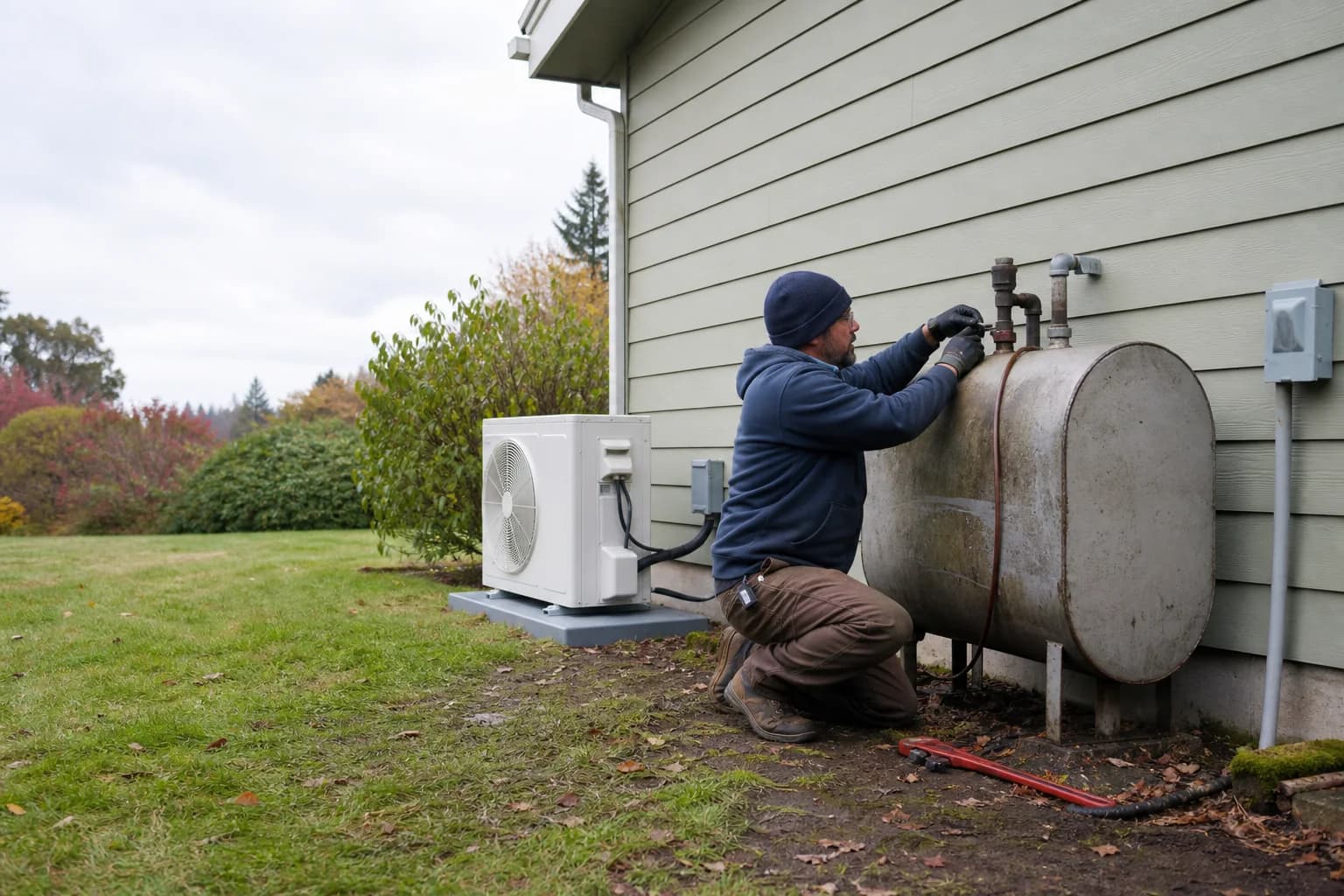
Two scenarios bring most Salem homeowners to this page. Tank failure: your existing heating oil tank is leaking, rusting through, or your insurer told you it has to go, and you need to decide whether to replace it with a new oil tank or convert to natural gas. Active conversion: you have already decided to convert to NW Natural gas, and the conversion contractor told you the oil tank has to be decommissioned before they finish the conversion.
In 2026 Salem, the math has shifted hard toward gas conversion. NW Natural service-area expansion now covers nearly every Salem-Keizer neighborhood. Energy Trust of Oregon and NW Natural rebates can offset $2,000 to $4,000 of conversion cost. And residential heating oil prices have stayed above natural gas equivalency for most of the last five years.
But conversion is not automatic and not always right. This guide walks through both paths: oil-to-oil tank replacement when you are staying on oil heat, and oil-to-gas conversion with the tank work that goes with it. For the underlying tank decommissioning process, see the complete oil tank removal guide.
// In this guide
- 01Why Salem homeowners are converting to gas in 2026
- 02NW Natural service area and the connection process
- 03The full conversion sequence, step by step
- 04Removing the tank vs abandoning in place during a conversion
- 05What a full conversion costs in 2026 Salem
- 06NW Natural and Energy Trust rebates that offset conversion cost
- 07Permits: coordinating the tank decommissioning and gas work
- 08Replacing the oil tank with a new oil tank (instead of converting)
- 09Timing a conversion: avoiding the winter heating gap
Why Salem homeowners are converting to gas in 2026
Conversion volume in Salem has roughly tripled over the past decade. Drivers behind the shift:
- 01NW Natural service area expansion. Coverage now reaches South Salem, NESCA, West Salem, Keizer, and most of the Marion County urban-growth boundary. Properties that were out of service area a decade ago are eligible today.
- 02Fuel cost. Residential heating oil in Salem ran $4.50 to $5.50 per gallon through much of 2024 to 2025. Natural gas equivalency was $1.80 to $2.40 per therm for similar heat output. The annual heating bill on a Salem rowhouse can drop $800 to $1,800.
- 03Reliability. Heating oil delivery scheduling, tank gauges that read wrong in cold weather, the inevitable mid-January out-of-fuel call. Gas is on-demand without homeowner monitoring.
- 04Insurance. Some Oregon insurers no longer renew homeowner's policies with active heating oil tanks. Conversion eliminates the issue.
- 05Resale. Properties with gas heat sell at slight premium vs equivalent oil-heat properties, particularly in the Salem-Keizer metro.
- 06Rebates and incentives. NW Natural and Energy Trust of Oregon offer combined incentives of $500 to $2,500 for conversions, plus additional rebates on high-efficiency gas furnaces.
NW Natural service area and the connection process
NW Natural is the natural gas utility for Salem-Keizer and most of western Oregon. Connecting service is more involved than turning on electricity but well-defined.
- 01Step 1: Confirm service availability. Salem-Keizer coverage is now nearly complete inside the urban growth boundary. NW Natural's online address-lookup tool confirms availability in 30 seconds.
- 02Step 2: Request a connection estimate. NW Natural sends a representative to the property to scope the line route from the street main to the meter location. Free.
- 03Step 3: Connection cost. Standard residential connection inside the existing main coverage runs $0 to $1,200 depending on distance from main and meter location. New service expansion (where main extension is required) can run $3,000 to $8,000+ but is often partially subsidized.
- 04Step 4: Connection scheduling. NW Natural typically schedules within 4 to 8 weeks. Peak fall demand (September to November) sometimes stretches to 10 to 12 weeks.
- 05Step 5: Inside work. Once the meter is set, a licensed plumbing/HVAC contractor handles the inside gas piping, furnace connection, and gas appliance hookups. This is separate from NW Natural's scope.
Note
NW Natural will not connect service to a property with an active heating oil tank that has not been decommissioned. The conversion sequence is always: decommission oil tank, install new gas line, hook up gas furnace. Decommissioning is the first step, not optional and not parallel.
The full conversion sequence, step by step
A complete Salem-area oil-to-gas conversion has 6 phases. Total timeline is 6 to 12 weeks depending on permit and NW Natural scheduling.
- 01Phase 1: Pre-work planning (2 weeks). NW Natural service estimate, HVAC contractor walkthrough for gas furnace sizing, oil tank decommissioning quote, Energy Trust application.
- 02Phase 2: Oil tank decommissioning (2 to 4 weeks elapsed, 1 to 2 days on site). Permit, site survey, tank pump and clean, removal or abandonment in place, soil sampling, backfill. Full process here.
- 03Phase 3: NW Natural service connection (4 to 8 weeks elapsed). Schedules independently of the tank work; can run in parallel once the tank decommissioning is scheduled. Meter installed at the property.
- 04Phase 4: Inside gas piping (1 to 3 days). Licensed plumber/HVAC runs gas line from meter to furnace location, runs additional drops for gas range, dryer, or hot water if requested.
- 05Phase 5: New gas furnace installation (1 to 2 days). Remove old oil furnace, install new gas furnace, connect supply and return, ductwork modifications if needed.
- 06Phase 6: Decommissioning Report and final inspection (2 to 4 weeks elapsed). DEQ filing of the oil tank Decommissioning Report, final inspection of gas work by City of Salem or jurisdiction, NW Natural turn-on.
Tip
Phases 2 and 3 run in parallel. Phase 2 starts as soon as you sign with the licensed oil tank provider; Phase 3 starts as soon as NW Natural schedules. With good coordination, the entire conversion can complete in 6 to 8 weeks instead of 10 to 12.
Removing the tank vs abandoning in place during a conversion
A gas conversion forces a tank decision but does not dictate the answer. You can remove the tank fully (excavate, lift out, dispose) or abandon it in place (pump, clean, fill with controlled low-strength material, leave in ground).
Both produce a Decommissioning Report and satisfy DEQ. The choice usually comes down to access, cost, and surface restoration:
- 01Remove if: Tank is accessible (clear yard, no driveway or addition over it), surface restoration is cheap (sod, gravel), you want the cleanest possible DEQ record. Typical Salem cost: $1,400 to $3,500.
- 02Abandon in place if: Tank is under a poured driveway or addition where excavation would require structural work, mature landscaping you want to preserve, or the homeowner just wants to be done with minimal yard disruption. Typical Salem cost: $1,100 to $2,200.
- 03Either way: Soil sampling is still required. Abandonment is not a way to skip the sampling.
Note
During a gas conversion, abandonment in place is more common than at other times because the excavation is harder to justify when the tank is no longer in service. It still has to meet the same DEQ conditions, and the soil sampling requirement does not go away.
What a full conversion costs in 2026 Salem
A complete oil-to-gas conversion runs $5,500 to $15,000+ in the Salem-Keizer market in 2026. Breakdown by component:
- 01Oil tank decommissioning: $1,100 to $2,800. Abandonment in place ($1,100 to $2,200) or full removal ($1,400 to $3,500). Detailed cost breakdown.
- 02NW Natural service connection: $0 to $1,500. Inside the urban core, often $0 (NW Natural absorbs as part of system expansion). New service expansion areas: $1,000 to $8,000+ (often partially subsidized).
- 03Inside gas piping: $800 to $2,500. Run from meter to furnace, plus optional drops for range, dryer, water heater. Depends on distance and complexity.
- 04New high-efficiency gas furnace: $3,500 to $7,500 installed. 95% AFUE units typical in the Salem climate. Higher-efficiency 97% units run $5,500 to $9,000.
- 05Old oil furnace removal: $200 to $600. Pump residual fuel from feed line, disconnect, haul off.
- 06Permits and inspections. Mechanical and plumbing permits for the gas work, plus whatever the jurisdiction requires for the tank decommissioning. Two separate trades, so budget for both rather than assuming one covers the other.
Subtract the rebates (next section) and the typical net Salem conversion cost in 2026 lands between $4,000 and $11,000. Most conversions pay back in heating-bill savings inside 5 to 8 years.
NW Natural and Energy Trust rebates that offset conversion cost
Several incentive programs apply to Salem-area conversions. Stacking them takes some coordination but adds up to significant savings:
- 01NW Natural conversion incentive: $500 to $1,000. Direct check from NW Natural for residential customers converting from electric or oil to gas. Application filed by the homeowner or contractor.
- 02Energy Trust of Oregon furnace rebate: $300 to $750. Performance-based rebate on high-efficiency gas furnaces (95% AFUE minimum). Filed through a participating contractor.
- 03Energy Trust of Oregon weatherization rebates: $500 to $2,000. Available when conversion is paired with attic insulation, duct sealing, or window upgrades. Stack with the furnace rebate.
- 04Energy Trust of Oregon loan program. Low-interest financing for full conversion projects, repaid through the gas utility bill over 5 to 15 years.
- 05Federal tax credits. The Inflation Reduction Act provides tax credits on high-efficiency natural gas furnaces (the 25C credit). Typically $300 to $600 depending on the specific equipment.
- 06Nothing offsets a contamination cleanup. Conversion incentives cover the equipment and the decommissioning, not a release. If sampling turns up contamination, that cost falls entirely to the owner under the Oregon DEQ oil tank rules, so budget it separately from the conversion.
Permits: coordinating the tank decommissioning and gas work
A conversion involves multiple permits across two or three jurisdictions:
- 01Oil tank decommissioning permit. City of Salem or Marion/Polk County. $120 to $250. Pulled by the licensed oil tank service provider.
- 02Gas piping permit. City of Salem mechanical/plumbing. $100 to $300. Pulled by the licensed gas contractor.
- 03Furnace installation permit. Same jurisdiction as the gas piping. Often combined with the gas permit. $50 to $150.
- 04NW Natural service connection. Not a homeowner permit; NW Natural handles its own utility permits for trenching to the meter.
A homeowner does not pull these permits directly; the licensed contractors do. But the homeowner is responsible for coordinating between the oil tank contractor and the gas/HVAC contractor so the sequencing works.
Replacing the oil tank with a new oil tank (instead of converting)
A small minority of Salem-area homeowners replace a failing oil tank with a new oil tank rather than converting. Reasons this still happens:
- 01Property is outside NW Natural service area. Rare in the Salem-Keizer urban growth boundary, but applies to some outer Marion and Polk County properties.
- 02Existing oil furnace is recent and high-efficiency. Replacing the tank only (rather than the full conversion to gas) preserves the furnace investment. Typical scope: decommission old tank, install new aboveground steel or fiberglass tank, transfer the supply line.
- 03Backup heat preference. Some Salem-area owners prefer redundant heating systems and want to keep oil heat as primary.
New tank installation cost: $1,800 to $3,500 for a 275-gallon aboveground replacement, plus the decommissioning cost for the old tank. Underground replacement is rare (most counties no longer permit new buried residential heating oil tanks in Oregon).
Watch out
Before committing to tank replacement, run the numbers on conversion. Even with the higher upfront cost, conversion usually has a shorter payback than installing a new oil tank. The rebates available for conversion (not for replacement) tip the math further.
Timing a conversion: avoiding the winter heating gap
The single most common conversion mistake in Salem is starting too late in the year and getting caught between fuel sources when cold weather hits.
- 01Best window: April through August. Heat is not needed during the swap, NW Natural and HVAC contractor schedules are open, permit offices are not backed up.
- 02Acceptable window: September through October. Doable but requires good coordination and lead time. Aim to complete by mid-October.
- 03Hard window: November through March. Possible but stressful. Cold-weather scheduling delays compound, and a 1-week schedule slip becomes a 1-week heating-emergency window.
Tip
If you find yourself converting in winter, keep the oil heat system functional until the gas furnace is operational and inspected. Some homeowners keep just enough oil in the tank to bridge a worst-case timing gap. The oil tank decommissioning can wait 30 to 60 days after the gas furnace is running.
Ready to schedule a Salem-area decommissioning?
Free site survey, fixed-price written quote, full DEQ closeout documentation. Most surveys scheduled within 48 hours.
Request a Written QuoteMore Salem guides on this topic
Replacement & Conversion: Common Questions
Will converting to gas actually save me money?
Can I keep my old oil tank as backup?
What happens to the oil in my tank when I convert?
Do I need to replace my ductwork during a conversion?
How long is NW Natural's wait time in 2026?
What if I am converting because of a buyer requirement in escrow?
Will the oil tank be excavated or filled during a conversion?
Can I do the gas conversion in stages over a year or two?
Related services and references
Guide
Complete Salem Oil Tank Removal Guide
The underlying tank decommissioning process.
Guide
Oil Tank Removal Cost in Salem
What each line item of the conversion actually costs.
Guide
Oregon DEQ Oil Tank Rules
DEQ closeout requirements that apply to conversion tank work.
Guide
Selling or Buying a Salem Home with an Oil Tank
When conversion is being driven by a real-estate transaction.
Service
Oil Tank Abandonment in Place
The most common decommissioning method during conversions.
Service
Underground Oil Tank Removal
Full removal when access permits.