
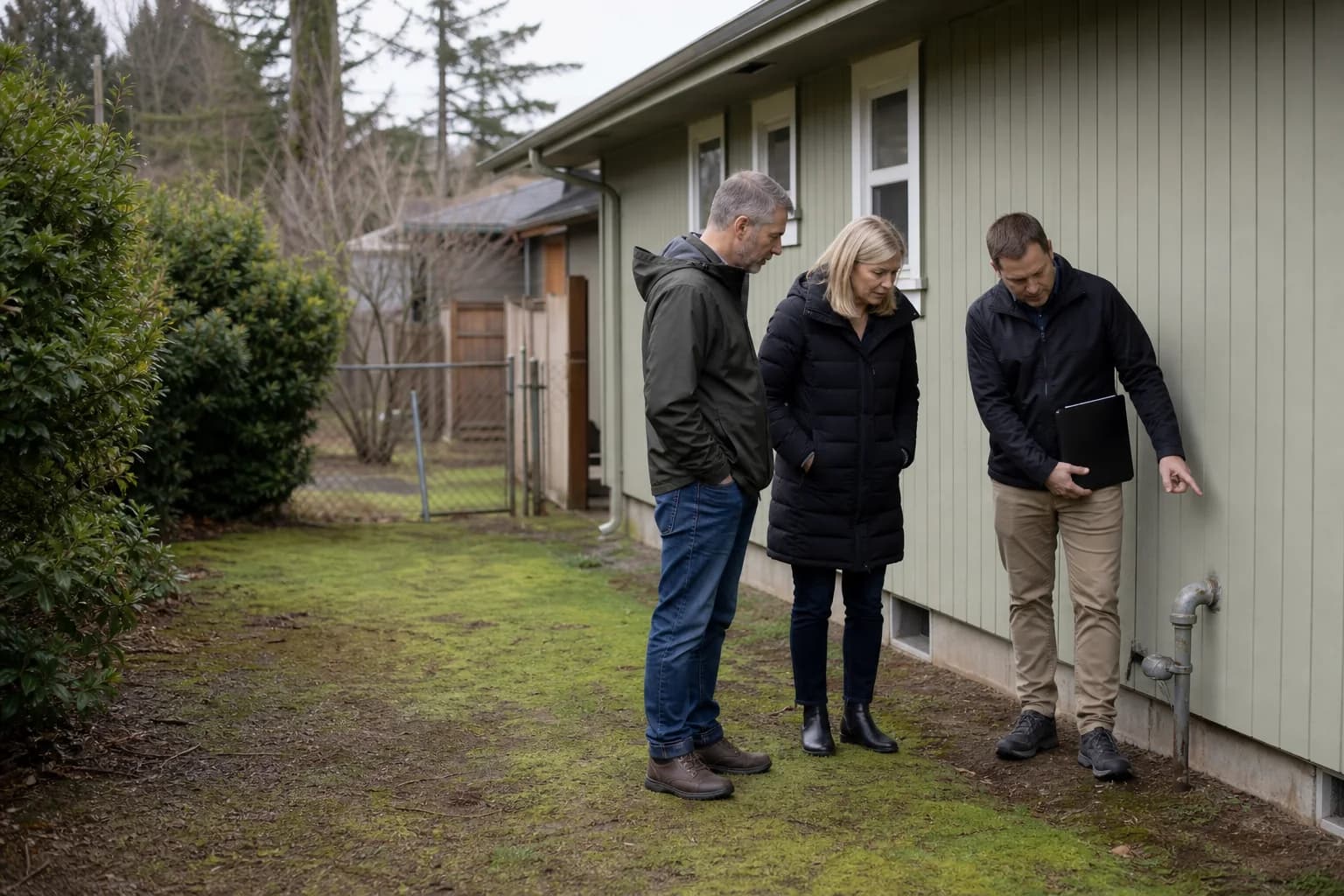
A heating oil tank discovered (or suspected) during a Salem-area real-estate transaction is one of the most common deal-friction issues at closing. Oregon law (ORS 105.464+) requires sellers to disclose known oil tanks. Most lenders will not close on a property with an undocumented tank. The standard 14-day inspection contingency and 30-day close timeline puts pressure on a process that normally takes 5 to 8 weeks end to end.
The good news: this is a solvable problem. Salem-area transactions involving heating oil tanks close every week. The trick is knowing the timeline, the documentation, and what each party (seller, buyer, agent, lender, title company) needs to release the closing.
This guide walks through both sides: what sellers need to do before listing or once a buyer raises the issue, and what buyers should do during due diligence and through to closing. For the underlying decommissioning process, see the complete oil tank removal guide.
// In this guide
- 01Oregon's seller disclosure law (ORS 105.464)
- 02What buyers see in the DEQ database
- 03Sellers: handle the tank before you list
- 04Sellers: when escrow forces the issue
- 05Buyers: due diligence on a Salem property with a tank
- 06Contingency language for buyers requiring decommissioning
- 07Lender requirements: who needs what at closing
- 08Title insurance and known UST exclusions
- 09Negotiating with confirmed contamination
Oregon's seller disclosure law (ORS 105.464)
Oregon's seller property disclosure statement, required under ORS 105.464 through 105.490, asks sellers about known and suspected heating oil tanks. The statement is not a contract or warranty, but it is a legal disclosure that buyers rely on and that can be the basis for post-closing claims if material facts are concealed.
The relevant questions on the standard form ask:
- 01Whether the property has a heating oil tank. Buried, basement, or aboveground. Answers: yes / no / unknown.
- 02Whether the tank is currently in use. Active for heating, inactive, or unknown.
- 03Whether the seller has knowledge of any prior decommissioning. If a tank was removed before purchase by the current seller, this is asked.
- 04Whether the seller has knowledge of any release or contamination. Active or historical.
- 05Whether documentation exists (Decommissioning Report, Cleanup Report, No Further Action letter).
Note
"Unknown" is a legitimate answer when the seller genuinely does not know. But unknown will almost always trigger a buyer-side investigation (tank locate, DEQ database check) before closing. Most lenders treat unknown as a closing condition that must be resolved.
What buyers see in the DEQ database
Oregon DEQ maintains a public database of heating oil tank decommissionings and cleanup cases. The database is searchable by address and is checked routinely by buyer agents, home inspectors, and lender underwriters during due diligence.
The database entries fall into a few categories:
- 01No record. Either no tank ever existed at the property, or a tank existed and was decommissioned without filing a Decommissioning Report (pre-1990s removal, or unlicensed work). Buyers and lenders treat this as "tank status unknown" and may require a tank locate.
- 02Decommissioned with clean sample results. Tank was removed or abandoned under OAR 340-177, soil samples below cleanup levels, Decommissioning Report on file. This is the ideal outcome for a sale.
- 03Decommissioned with localized cleanup. Tank removed, some soil contamination found, contamination excavated, confirmation samples clean, supplemental report on file. Reads as a closed case. Some buyers will still want to see the full documentation.
- 04Open Cleanup Rule case. Tank removed, contamination confirmed, cleanup in progress. Sale typically does not proceed without buyer-side acceptance of the open case (rare, usually requires significant price reduction and seller-funded completion).
- 05No Further Action letter on file. Cleanup completed, DEQ has issued NFA. Reads as a fully closed case. From a buyer perspective, almost as good as a clean decommissioning, and sometimes preferred because it documents that contamination was professionally handled.
Sellers: handle the tank before you list
Salem sellers with a known oil tank should plan to decommission before listing whenever possible. The math is simple: a property with a Decommissioning Report already on file sells faster, attracts more buyers, and closes at a higher net than the same property where the buyer has to wait through the decommissioning process during escrow.
Pre-listing benefits:
- 01No closing-window pressure. Lab turnaround takes 2 to 3 weeks. Doing this before listing eliminates the friction.
- 02Wider buyer pool. Cash buyers and conventional loans both proceed without issue when documentation is in hand. FHA/VA loans are easier when the file is closed.
- 03No negotiated price reduction. Buyers asking the seller to decommission during escrow typically ask for a $1,000 to $3,000 credit even when actual cost is similar. Pre-listing avoids this.
- 04Removes the contamination risk surprise. If a release is found, you handle it on your timeline rather than the buyer's. Many releases close with localized cleanup that does not derail anything; finding out during escrow is much more disruptive.
Tip
A typical clean decommissioning in Salem takes 5 to 8 weeks from quote to filed report. If you list 8 weeks after starting the decommissioning, the report is in hand when the first offer comes in.
Sellers: when escrow forces the issue
Sometimes pre-listing is not possible. The tank surfaces during a buyer's inspection, the contingency clock starts, and you have 14 to 30 days to handle it. The process compresses but stays workable:
- 01Days 1-3: get quotes. Two or three quotes from DEQ-licensed providers. Confirm permit pull, soil sampling protocol, and Decommissioning Report drafting are included.
- 02Days 3-5: choose and book. Pick the provider, sign, schedule the work. Most established Salem-area providers can book within 2 to 5 business days.
- 03Days 5-15: permit and work. 3 to 7 business days for permit, 1 to 2 days on site. Soil samples ship same day to ORELAP lab.
- 04Days 15-30: lab and preliminary results. Typically 5 to 14 business days for TPH-Dx and BTEX. Rush turnaround is available at a premium when the contingency window is tight.
- 05Days 30-45: Decommissioning Report. Drafted, photographed, filed. Some lenders accept the preliminary lab results plus contractor letter; others want the full filed report.
Watch out
If contamination is found mid-escrow, the timeline blows out. Plan for either a closing extension (most agents and buyers will work with 30-60 day extensions when the cleanup is in good hands) or a price renegotiation with the seller funding the cleanup or crediting the buyer.
Buyers: due diligence on a Salem property with a tank
If you are buying a Salem-area property and the seller disclosure says "yes, oil tank" or "unknown," your due diligence checklist:
- 01Pull the DEQ database entry. Search the address in DEQ's Heating Oil Tank database. Review what is on file: decommissioning, cleanup, current status.
- 02Request Decommissioning Report if any. Seller (or seller's agent) should be able to produce a copy of any prior Decommissioning or Cleanup Report.
- 03Tank locate if status is unknown. $300 to $500 geophysical scan with ground-penetrating radar or magnetometer. Confirms presence or absence definitively.
- 04Visual inspection. Walk the property looking for vent pipes, fill caps, patched asphalt, basement supply-line stubs.
- 05If a tank is present and not decommissioned: get a quote. So you know the actual remediation cost before deciding whether to require seller-funded decommissioning or to take a credit.
- 06If a tank was removed years ago without documentation: consider sampling. A retroactive sampling exercise ($1,500 to $3,000) tells you whether there is hidden contamination. Some buyers skip this; some lenders require it.
Contingency language for buyers requiring decommissioning
Oregon Real Estate Forms (OREF) repair-addendum and inspection-response language gives buyers leverage to require oil tank decommissioning as a condition of closing. Common variations:
- 01"Seller to decommission tank by [licensed DEQ contractor] prior to closing, with full Decommissioning Report delivered to buyer." Strongest buyer position. Seller bears all cost and risk.
- 02"Seller to credit buyer $[X] at closing in lieu of decommissioning." Used when timeline does not allow pre-closing work or buyer prefers to manage the work themselves post-close. Credit amount should reflect realistic 2026 Salem rates: $2,000 to $3,500 for a clean job, more if contamination is suspected.
- 03"Closing date extended to allow tank decommissioning and clean soil sample results; if soil samples confirm release, parties to renegotiate." Used when contamination probability is unknown. Protects both sides; requires good-faith follow-through.
- 04"Buyer accepts property with tank in place; seller indemnifies buyer against any future cleanup costs related to tank for [N] years." Rare. Used when tank is in good condition and buyer wants to keep it active for heating. Most Salem lenders will not write the loan under these terms.
Lender requirements: who needs what at closing
Lenders write the rules at closing because they want their collateral (the house) free of environmental liabilities. Different lenders handle the issue differently:
- 01Large national banks. Generally require decommissioning of any known UST as a closing condition, and generally require a tank locate when the disclosure is "unknown" and inspection raises any flag.
- 02Credit unions and regional lenders. Broadly similar in approach, with some underwriters willing to accept an in-progress decommissioning backed by preliminary lab results. Confirm with the specific lender rather than assuming.
- 03FHA-backed loans. Strict. Active or undocumented USTs will not close. FHA appraiser flags the tank, and the appraisal cannot be cleared until decommissioning is complete and on file.
- 04VA loans. Similar to FHA, strict.
- 05USDA Rural Development loans. Strict, similar to FHA.
- 06Conventional loans without lender-side environmental scrutiny. Some lenders write the loan without requiring tank decommissioning. This is the exception rather than the rule, and it is getting rarer.
- 07Cash buyers. No lender requirement. Buyer can accept tank in any condition. But future resale to a financed buyer will face the same issues, so cash buyers usually still negotiate for decommissioning.
Title insurance and known UST exclusions
Most title insurance policies exclude known environmental conditions, including documented heating oil tanks. The exclusion does not prevent closing; it just means the title insurer is not on the hook for tank-related claims after the sale.
- 01Standard exclusion. "This policy does not insure against loss or damage arising from the existence of any heating oil tank or any release of petroleum products from such tank."
- 02What this means practically. If a buried tank is discovered after closing that was not disclosed, the buyer has a claim against the seller (under disclosure law) and possibly the previous title company (for missed-record issues), but not against the title insurer.
- 03Closed-case properties. A property with a clean Decommissioning Report and No Further Action letter on file usually does NOT trigger the exclusion, because there is no known existing tank. Title insurance proceeds as standard.
- 04What buyers can do. Title insurance affirmative coverage (paid endorsement) is sometimes available for tank-related risks. Underwriting and cost varies by title company.
Negotiating with confirmed contamination
If sampling during decommissioning confirms a release, the deal shifts. Salem-area transactions handle this in three common ways:
- 01Seller funds the cleanup, closing extends. Most common. Seller commits to running the cleanup to completion, parties agree on a revised closing date 60 to 90 days out. The full cost sits with the seller, because Oregon has no reimbursement fund or insurance pool for residential heating oil cleanup.
- 02Buyer takes a credit and inherits the cleanup. Less common because the buyer is taking on an active DEQ case, and DEQ holds the current owner responsible for necessary cleanup even where the leak predates the purchase. Used when the buyer is a contractor or otherwise comfortable managing the cleanup, or when the seller wants out fast. The credit has to carry the whole estimated cost, since nothing reimburses it later.
- 03Deal falls apart. Sometimes happens when the cleanup tier exceeds expectations (Tier 3 case with groundwater impact). Most parties prefer to renegotiate than to terminate, but it does occur.
Tip
A confirmed release does not mean the deal dies. Most Salem-area Tier 1 and Tier 2 releases resolve well short of the worst case, though the exact schedule depends on lab turnaround and DEQ review. Get the cleanup scope and timeline from a licensed provider before deciding to renegotiate or terminate, and price the renegotiation against what each contamination tier actually costs.
Ready to schedule a Salem-area decommissioning?
Free site survey, fixed-price written quote, full DEQ closeout documentation. Most surveys scheduled within 48 hours.
Request a Written QuoteMore Salem guides on this topic
Real Estate: Common Questions
How long before listing should I start the decommissioning?
Can I sell "as-is" with the tank still in the ground?
What if I do not know if a tank exists on the property?
My agent told me to just answer "unknown" on the disclosure. Is that safe?
Does buying a home with a clean Decommissioning Report mean I have zero risk?
Can the buyer require the seller to remove a basement tank that is still in use?
What if I find a tank during my own buyer inspection that the seller did not disclose?
Will the tank issue come back up at my next sale?
Related services and references
Guide
Complete Salem Oil Tank Removal Guide
The full decommissioning process the transactions reference.
Guide
Oil Tank Removal Cost in Salem
What it actually costs to settle the issue before listing or at escrow.
Guide
Oregon DEQ Oil Tank Rules
The regulatory background lenders and title companies reference.
Guide
Oil Tank Replacement & Gas Conversion
When the new buyer plans to convert and the tank has to go.
Service
Underground Oil Tank Removal
Standard pre-sale decommissioning workflow.