
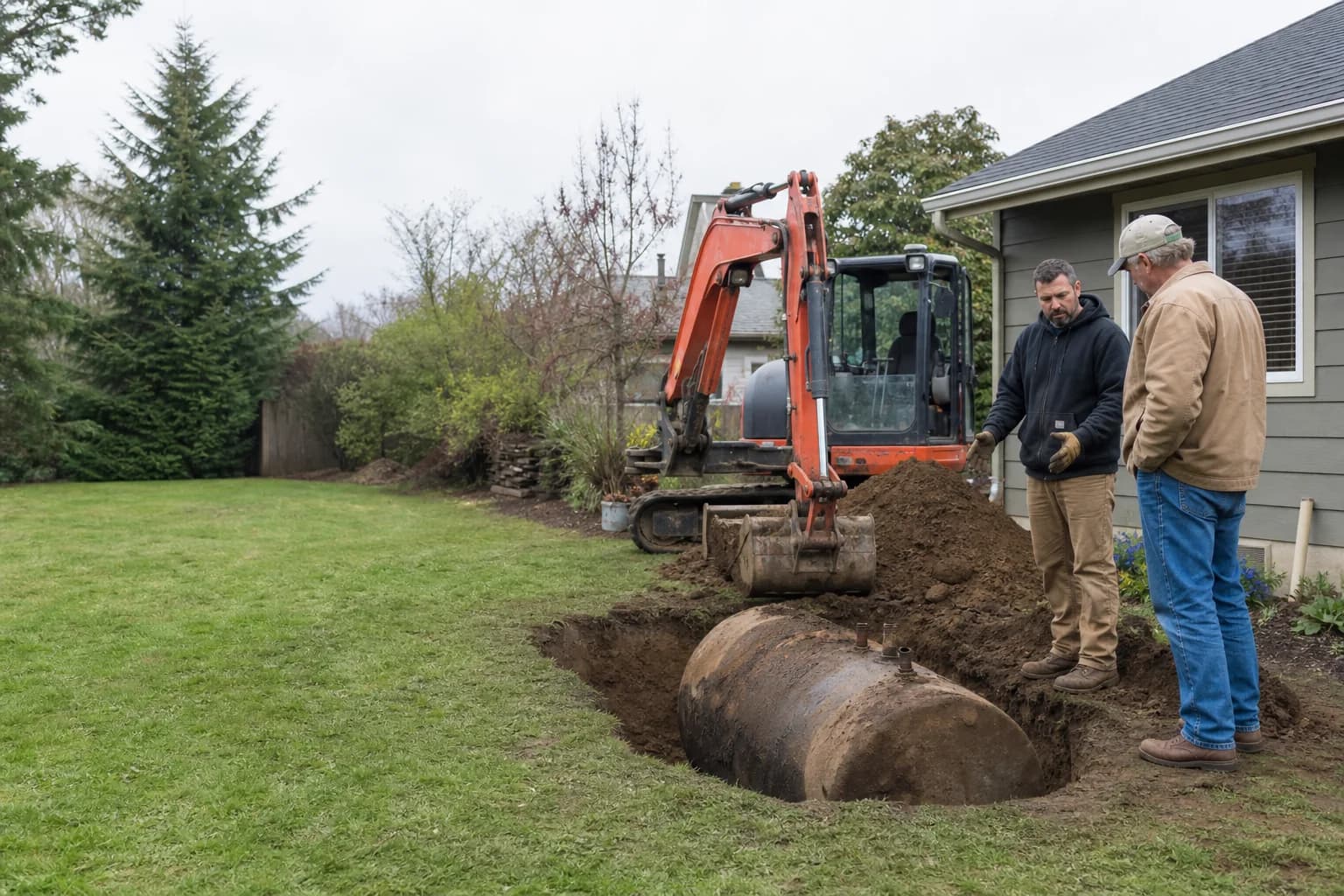
If a buyer's lender just flagged "unknown UST" in your Salem property file, or a heating-oil tank in your yard just failed, or you are converting to natural gas and the conversion contractor told you the tank has to go: this guide walks through every decision you are about to make.
Most Salem-area underground heating oil tank decommissionings land between $1,400 and $3,500 when the soil is clean, varying with tank size and access. Where sampling reveals a release and Oregon DEQ requires a cleanup, the job typically runs $3,500 to $80,000+ depending on how far the oil spread. The work is regulated under the Oregon DEQ Heating Oil Tank (HOT) Program, must be performed by a DEQ-licensed service provider, and ends with a Decommissioning Report that buyers, lenders, and title companies will ask for at closing.
This guide covers the full picture: when removal is required, what the work involves, what it costs, and the documentation you walk away with. Deeper dives on individual topics like detailed cost ranges, DEQ regulations, real-estate timelines, and gas conversion sit on their own pages.
// In this guide
- 01When Salem homeowners deal with an oil tank
- 02The three tank types you will find in Salem
- 03The Oregon DEQ Heating Oil Tank (HOT) Program in plain English
- 04The decommissioning process: what actually happens on site
- 05Soil testing: what gets sampled, what happens if a release shows up
- 06What it costs in Salem in 2026
- 07The Decommissioning Report: what it is, why it matters
- 08Removal vs abandonment in place: when Oregon allows each
- 09Real estate: what Salem sellers and buyers need to know
- 10Choosing a DEQ-licensed service provider in Salem
When Salem homeowners deal with an oil tank
Four scenarios drive almost every Salem-area oil tank decommissioning. Knowing which one applies to you tells you how urgent the timeline is and which documents you are going to need.
- 01Real-estate transaction. A buyer's lender or home inspector flags the presence (or possible presence) of a buried heating oil tank, and the closing cannot proceed until the tank is decommissioned and a DEQ Decommissioning Report is on file. This is the most common trigger in Salem. Timeline is set by escrow, usually 14 to 30 days.
- 02Conversion to natural gas. You signed a deal with NW Natural to bring a gas line to the property, and the conversion contractor wants the heating oil tank out of the system before they cap it. Often the oil tank stays in the ground if it is in good condition (abandonment in place), or comes out if access is easy.
- 03Active or suspected leak. You smell oil in the basement, see a stain in the soil where the tank sits, the fuel gauge keeps falling without a delivery, or a neighbor's well test came back with TPH. This becomes a release investigation, not a routine decommissioning.
- 04Insurance non-renewal or homeowner choice. Your insurer notified you that they will not renew the policy with an active heating oil tank on the property, or you simply want to be done with the liability. No external pressure on timeline, which means you can usually save money by scheduling outside peak season.
Note
If a sale is in escrow, the closing date sets your timeline. Most Salem-area decommissionings take 1 to 2 working days on site plus another 2 to 6 weeks for soil-sample lab turnaround and the Decommissioning Report to be drafted and filed.
The three tank types you will find in Salem
Heating oil tanks in the Salem area fall into three categories. Which one you have determines the entire process: the permit pathway, the cost, the equipment crews bring, and the documentation that comes out the other side.
- 01Underground storage tanks (USTs). Buried in the front or side yard, usually 250 to 500 gallons, almost always single-wall 12-gauge steel installed between 1945 and 1985. This is the type the Oregon DEQ HOT Program is built around, and the type that requires a Decommissioning Report. See our service page for underground oil tank removal for the technical workflow.
- 02Aboveground storage tanks (ASTs) outside. Sitting on legs or a concrete pad against the side of the house, typically 275-gallon oval. Easier to remove because no excavation is involved, but DEQ still requires proper handling of the residual product and the tank steel. The aboveground tank removal page walks through the cut-and-recycle workflow.
- 03Basement or crawl-space tanks. Usually 275-gallon oval, installed indoors when the house was built. Decommissioning is constrained by interior access; sometimes the tank gets cut into pieces in place. No DEQ Decommissioning Report is required for basement tanks because they are not USTs, but most lenders and buyers still want documentation that the tank was professionally removed.
Tip
Not sure if you even have a tank? Old Salem-area homes built before about 1985 frequently had buried oil tanks installed and then forgotten about. Visual clues include a vent pipe or fill cap protruding from a flower bed, an old patched section of driveway, or a basement wall stub that used to be a supply line. If you cannot find one but a buyer's lender is asking, a tank locate (a $300-$500 geophysical scan with ground-penetrating radar or magnetometer) confirms presence one way or the other.
The Oregon DEQ Heating Oil Tank (HOT) Program in plain English
Oregon regulates residential heating oil tank decommissioning under OAR 340-177, administered by the Department of Environmental Quality (DEQ) HOT Program. The rules are stricter than most homeowners expect because of Oregon's groundwater-protection priorities and the Willamette Valley's shallow water table.
In plain English, here is what the program requires:
- 01The decommissioning must be performed by a DEQ-licensed service provider. "Licensed" is not optional. Hiring a friend with an excavator is illegal under OAR 340-177 and will not produce the Decommissioning Report that closes the file with DEQ.
- 02Soil samples must be collected at decommissioning. Two to four samples from the tank pit, sent to an ORELAP-accredited lab, tested for TPH-Dx (total petroleum hydrocarbons in the diesel range) and BTEX (benzene, toluene, ethylbenzene, xylenes). Sample locations follow DEQ's sampling guidance.
- 03The Decommissioning Report closes the job. The licensed service provider compiles the soil sample results, photos of the work, tank dimensions, and the certified-disposal documentation, then submits the certification to DEQ for registration and entry into the Heating Oil Tank records. The homeowner gets a copy.
- 04Confirmed releases trigger the Heating Oil Cleanup Rule. If soil samples exceed DEQ's residential cleanup levels, the tank decommissioning becomes a release investigation. Additional sampling, excavation, soil disposal, and a separate Cleanup Report are required before DEQ will issue a "No Further Action" determination.
Watch out
Most Salem homeowners discover the licensing requirement when they get a price from someone $1,000 cheaper than the licensed quotes. Unlicensed work is unrecognized by DEQ, which means: no Decommissioning Report, no DEQ file, no clean property record, and your buyer's lender will not accept the closeout. Always verify the contractor's DEQ license number before signing.
The decommissioning process: what actually happens on site
A standard Salem-area underground heating oil tank decommissioning is a 1 to 2 day job. The work is straightforward when soil is clean; the timeline stretches when the lab work comes back showing a release. Here is the sequence:
- 01Day 0: site survey and permit. A licensed service provider walks the property, locates the tank (probe, GPR, or magnetometer if needed), confirms underground utility clearance with the Oregon Utility Notification Center (Call 811), and pulls the City of Salem or Marion/Polk County permit. Typical turnaround 3 to 10 business days.
- 02Day 1 morning: pump and clean. Crew arrives, exposes the tank top, pumps any residual fuel and sludge to a vacuum truck for off-site recycling. The tank is then cleaned to ASTM standards and verified vapor-free with a combustible gas indicator.
- 03Day 1 afternoon: cut and lift. The tank steel is cut into manageable pieces with a non-sparking saw and lifted out of the pit. Crew documents tank dimensions, condition (pinholes, corrosion, prior patches), and prepares the steel for recycling.
- 04Day 1 or 2: soil sampling. Two to four samples are pulled from the tank pit per DEQ guidance: typically one beneath each end of the tank footprint, one at the base, and one stockpile sample. Chain-of-custody form is signed; samples ship same-day to an ORELAP-accredited lab.
- 05Day 1 or 2: backfill. If the visual inspection shows no obvious contamination, the pit is backfilled with clean fill and compacted in lifts. The site is restored: sod, gravel, or whatever surface was originally there.
- 06Days 7 to 21: lab turnaround. The lab returns TPH-Dx and BTEX results. If all results are below DEQ's residential cleanup levels, the file proceeds to closure. If any result exceeds the screening level, a release determination is made and a separate scope of work begins.
- 07Days 30 to 60: Decommissioning Report. The service provider compiles the report (soil results, photos, tank dimensions, disposal manifests) and files it with DEQ. The homeowner receives a copy for the property file. See the full Salem pricing breakdown for what each step typically costs.
Soil testing: what gets sampled, what happens if a release shows up
Soil testing is the part that turns a routine decommissioning into a potentially expensive cleanup. A minority of Salem-area underground tank decommissionings reveal some level of release. Most of those are small and resolved by limited additional excavation; a smaller number become full DEQ Cleanup Rule cases.
Samples are pulled from beneath the tank footprint, screened for visual or olfactory indicators in the field, and shipped to an Oregon-accredited (ORELAP) laboratory. The two analyte panels that matter are TPH-Dx (heating oil is in the diesel range, C10 to C24) and BTEX (benzene is the trace constituent regulators care about most because of its mobility and toxicity).
- 01All samples below DEQ residential cleanup levels. File closes with a clean Decommissioning Report. No further work. This is the common outcome for Salem decommissionings.
- 02Localized exceedance. One or two samples exceed cleanup levels. Crew returns, excavates the affected soil, samples the new excavation boundary, repeats until the limits are below screening criteria. Soil is disposed of at a permitted facility. Typical cost adder: $3,500 to $12,000.
- 03Confirmed release with vertical or horizontal extent. Contamination has migrated beyond the immediate tank pit. Site characterization (additional borings, possibly groundwater monitoring), Cleanup Report, and DEQ No Further Action determination required. Full-cycle cost typically runs $15,000 to $80,000+, depending on extent. The property owner carries that cost; Oregon runs no reimbursement fund for residential heating oil cleanup.
Note
If a release is confirmed, do not panic. The Oregon DEQ HOT Program is specifically designed for residential heating oil cleanup and the standards are reasonable. Most full-cleanup cases end with a No Further Action letter that follows the property in DEQ's database. How long that takes is driven by lab turnaround and DEQ review, so it varies. The soil testing and cleanup service page walks through the full process.
What it costs in Salem in 2026
Here are the 2026 ranges for a Salem-area heating oil tank decommissioning. These reflect actual quotes inside the 97301 to 97309 corridor; coastal and Eastern Oregon markets run different rates.
- 01Underground tank, clean decommissioning, full removal: $1,400 to $3,500. Most common scenario. Includes permit, locate, excavation, pump and clean, cut and remove, two soil samples, backfill, ORELAP lab fees, Decommissioning Report.
- 02Underground tank, clean decommissioning, abandonment in place: typically $1,100 to $3,800. Tank stays in the ground (concrete or sand fill), no excavation. Allowed when removal would damage permanent structures like driveways or foundations.
- 03Aboveground tank removal, exterior: $700 to $1,400. No excavation, but DEQ still requires proper residual product handling and steel disposal documentation.
- 04Basement or crawl-space tank: $900 to $1,800. Includes pump, clean, cut in place, removal through doorways or stairwells, residual product disposal.
- 05Localized release cleanup adder: $3,500 to $12,000. Additional excavation, soil disposal, confirmation sampling, supplemental Decommissioning Report.
- 06Full DEQ Cleanup Rule case: typically $15,000 to $80,000+. Site characterization, groundwater monitoring if required, Cleanup Report, DEQ No Further Action letter. Whether the site qualifies for DEQ's generic remedy or falls to a risk-based cleanup is what moves this range.
Tip
The single biggest cost variable is whether soil samples come back clean. Everything else (depth of cover, distance to driveway, day of week) moves the number by hundreds of dollars; soil contamination moves it by tens of thousands. See the full Salem pricing guide for the per-line-item rate card.
The Decommissioning Report: what it is, why it matters
The Decommissioning Report is the document that closes the file. The licensed service provider submits it to DEQ as a certification, and DEQ registers it. It contains:
- 01The licensed service provider's certification and DEQ license number
- 02Tank dimensions, condition, manufacturer if known, prior repair history
- 03Soil sample locations diagrammed against the tank footprint
- 04Lab analytical results for TPH-Dx and BTEX
- 05Disposal manifests for the tank steel and residual product
- 06Photographs of the work
- 07Backfill specification and compaction records
Every Salem homeowner who is decommissioning a tank because of a real-estate transaction needs this document. The buyer, the buyer's lender, the title insurance company, and (eventually) the next buyer will all want to see it. DEQ also keeps a copy in its Heating Oil Tank database, which is searchable by address; a property with a recorded Decommissioning Report on file appears in the database as a closed-out site, which dramatically reduces friction for future transactions.
A licensed service provider files the report as standard practice. An unlicensed contractor produces no report at all, and the property does not appear in DEQ's system as decommissioned. This is the single most important reason to verify licensing before signing a decommissioning quote.
Removal vs abandonment in place: when Oregon allows each
Oregon DEQ allows two routes to decommissioning an underground tank: removal (excavate and pull out) and abandonment in place (pump, clean, fill with sand or controlled low-strength material, leave in ground). Both produce a Decommissioning Report. The choice is technical, not preferential. Abandonment is only allowed in specific scenarios.
- 01Removal is the default. Excavation gives the cleanest closeout: full tank inspection for pitting and pinholes, direct visual of the soil beneath the tank, full soil-sample coverage. Most Salem-area decommissionings go this route.
- 02Abandonment in place is allowed when removal would damage permanent structures. Examples: the tank sits directly under a concrete driveway extension, under a load-bearing addition, under a mature street tree the city would not permit removed, or within excavation-clearance distance of a foundation footing. The licensed provider documents the structural justification in the Decommissioning Report.
- 03Abandonment requires the same soil-sampling protocol. One important misconception: abandonment in place is NOT a way to skip the soil testing. DEQ still requires the same TPH-Dx and BTEX panel from the tank pit, just sampled through bore holes rather than open excavation.
- 04Abandonment is usually cheaper but produces a less marketable property record. The DEQ database flags abandonment-in-place tanks; future buyers will see the notation and may ask for additional evaluation. Whatever you save on the excavation often disappears at the next sale.
Tip
When in doubt, remove. Abandonment in place is the right choice when removal is genuinely impractical. See the abandonment in place service page for the technical workflow and when it makes sense.
Real estate: what Salem sellers and buyers need to know
Oregon law (ORS 105.464+) requires sellers to disclose known oil tanks on the seller property disclosure statement. "Known" is the operative word: if you genuinely do not know whether a tank exists, you can answer "unknown", but most lenders will then require a tank locate as a condition of closing.
Practical realities for Salem-area transactions:
- 01Lenders commonly flag unknown USTs. Many lenders, including on FHA-backed loans, instruct underwriters to either decommission or rule out a buried oil tank as a condition of closing. Cash buyers and conventional loans without buyer-side scrutiny sometimes proceed, but it is less common.
- 02Buyers can require decommissioning before closing. The standard Oregon Real Estate Forms repair-addendum language gives buyers leverage to require either tank removal or a DEQ-recognized No Further Action letter before signing the close.
- 03Timeline is the friction. A 14-day inspection contingency plus a 30-day close gives the seller about 44 days to get a tank decommissioned with full lab turnaround. Tight but doable. Tighter contingencies make full removal hard; sometimes a confirmed-clean Decommissioning Report arriving 1 week after close is acceptable to the buyer if escrow holds funds.
- 04If soil is contaminated, the deal stalls. Confirmed releases turn a 14-day contingency into a process that typically runs 1 to 6 months. Sellers in this scenario often switch to listing the property "with known UST contamination, cleanup in progress" and discount accordingly.
Note
If you are selling, get the decommissioning done before you list. A property with the Decommissioning Report already in hand and the DEQ file closed sells faster and at a higher net than a property where the buyer has to wait through the process.
Choosing a DEQ-licensed service provider in Salem
Oregon requires heating oil tank work to be performed by a DEQ-licensed service provider. Licensing covers the contractor's training, insurance, sampling protocol competency, and disposal compliance. There are roughly 30 to 40 DEQ-licensed providers active in the Salem and broader Willamette Valley market.
Things to verify before signing a decommissioning quote:
- 01DEQ license number on the proposal. Verify it against the DEQ Service Provider list. Active license, in good standing.
- 02General liability insurance and workers comp. Ask for the certificate of insurance and confirm the limits are appropriate to the scope of your job. Pollution-liability coverage matters if a release is suspected.
- 03Fixed-price quote, not "starting from." A licensed provider with Salem experience knows what the work costs. Open-ended quotes that hide the lab-fee and disposal-fee adders are a red flag.
- 04Written description of the soil-sample plan. The quote should specify how many samples will be pulled, where, and from which lab. ORELAP-accredited only.
- 05Decommissioning Report turnaround. 30 to 60 days from work completion is standard. Anything longer than that should be questioned.
- 06Local references. Salem-area work from the last 12 months, ideally including the same kind of tank you have. Pre-1985 buried single-wall steel is the type that needs the most specific experience.
Ready to schedule a Salem-area decommissioning?
Free site survey, fixed-price written quote, full DEQ closeout documentation. Most surveys scheduled within 48 hours.
Request a Written QuotePillar Guide: Common Questions
Do I really need to remove the tank, or can I just leave it?
How long does the whole process take from quote to Decommissioning Report?
Will my homeowner's insurance cover an oil tank leak?
Can I do the decommissioning myself to save money?
What if the buyer wants the tank decommissioned but my closing is in 2 weeks?
Does abandonment in place hurt resale value?
What is the difference between a Decommissioning Report and a Cleanup Report?
Are there grants or financial assistance for tank cleanup in Oregon?
Related services and references
Service
Underground Oil Tank Removal
Full UST decommissioning with DEQ filing. The most common Salem-area scope.
Service
Aboveground Oil Tank Removal
Exterior, basement, or crawl-space AST removal with residual handling.
Service
Oil Tank Abandonment in Place
When removal would damage structures. Same DEQ filing, fill in place.
Service
Soil Testing & Contamination Cleanup
TPH-Dx and BTEX sampling, DEQ Cleanup Rule cases, No Further Action determinations.
Guide
Oil Tank Removal Cost in Salem
Detailed 2026 pricing breakdown by scenario and tank type.
Guide
Oregon DEQ Oil Tank Rules
Plain-English breakdown of OAR 340-177 and the HOT Program.
Guide
Selling or Buying a Salem Home with an Oil Tank
Real-estate timelines, lender requirements, contingency language.
Guide
Oil Tank Replacement & Gas Conversion
Step-by-step when converting from oil heat to natural gas in Salem.