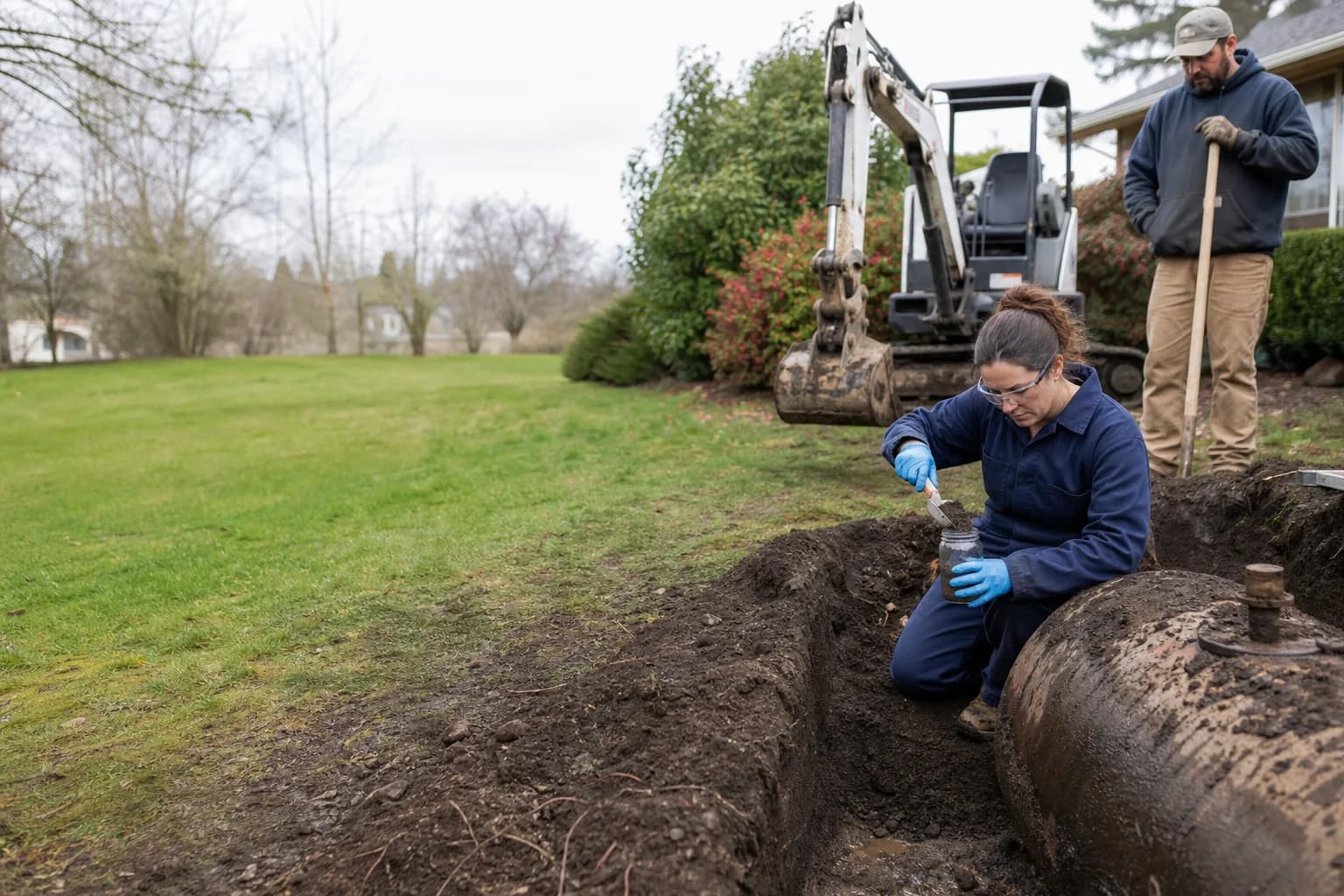
A minority of Salem-area underground heating oil tank decommissionings turn up at least some level of soil release. Most of those are small and resolved with a few cubic yards of additional excavation. Less often, a case becomes a full Oregon DEQ Cleanup Rule matter that runs for months and into five figures. Either way, the steps are well defined and the outcome is predictable.
Oregon regulates residential heating oil releases under OAR 340-122 and the DEQ Heating Oil Tank (HOT) Program. The screening levels, the analyte panels, and the documentation are all standardized. What is not available is money: Oregon has no reimbursement fund or insurance pool for residential heating oil cleanup, and DEQ is explicit that the current owner of the property is responsible for any necessary cleanup even if the leak happened before he or she bought the property. This guide walks through every part: how a release gets confirmed, what the DEQ cleanup levels actually are, the cost ranges Salem homeowners are quoted in 2026, and how qualifying for DEQ's generic remedy changes the number.
Contamination is the branch nobody plans for. A routine Salem decommissioning ends when the samples come back clean, and everything below applies only when they do not. What changes at that point is the governing rule, because a confirmed release moves the job out of the standard OAR 340-177 workflow and into a cleanup with its own reporting and closure requirements.
// In this guide
- 01How a release actually gets confirmed
- 02The two analyte panels: TPH-Dx and BTEX, in plain English
- 03Oregon DEQ residential cleanup levels: the numbers that matter
- 04The cleanup workflow: from confirmed release to No Further Action
- 05What a Salem cleanup actually costs in 2026
- 06Who pays for a Salem heating oil cleanup
- 07The cleanup route is what controls the bill
- 08Real estate: selling a Salem home with an active release
- 09Choosing a cleanup contractor in the Salem market
How a release actually gets confirmed
There are three pathways into a confirmed release file. Each one looks different on the homeowner side, but they all end at the same DEQ desk.
- 01Field-visual or olfactory detection at decommissioning. Crew opens the pit, the soil under the tank is stained black or grey and smells of heating oil. Field-screened with a photoionisation detector to triage; samples pulled regardless because the visual is not the regulatory standard. About half of confirmed Salem releases are first noticed this way.
- 02Lab analytical exceedance. The pit looks visually clean, samples go to the ORELAP-accredited lab, and TPH-Dx or BTEX returns above the DEQ residential cleanup level. This is the most common pathway in Salem because Willamette Valley silt loam soils mask staining and small chronic seepage. The release call is made by the lab number, not the field eye.
- 03Off-property indicator. A neighbor's well test, a stormwater catch-basin sample, or a sheen on a nearby surface-water feature comes back with heating oil markers and DEQ traces it to your tank. Rare but it does happen, especially on properties near Mill Creek, the Willamette, or shallow groundwater areas.
Note
Photoionisation detector hits in the field are not a regulatory call. A high PID reading triggers more sampling; the lab number on the certified report is what closes or opens the file. Field instruments cannot substitute for ORELAP results.
The two analyte panels: TPH-Dx and BTEX, in plain English
DEQ's heating-oil release standard rests on two laboratory analyte panels. Both come from the same ORELAP-accredited lab on the same sample. Together they fingerprint heating oil and the trace components inside it that drive the toxicity calculation.
- 01TPH-Dx (total petroleum hydrocarbons, diesel range). Heating oil is functionally diesel from a chemistry perspective. The lab quantifies the C10 to C24 carbon-chain range and reports milligrams per kilogram of soil. This is the bulk indicator: how much heating oil is in the soil. The relevant method in Oregon is NWTPH-Dx (Northwest Total Petroleum Hydrocarbons, diesel extension), sometimes written NWTPH-HCID for the hydrocarbon identification variant.
- 02BTEX (benzene, toluene, ethylbenzene, xylenes). Trace aromatic constituents inside heating oil. Benzene is the one regulators care about most because it is mobile in groundwater and a known human carcinogen. EPA method 8260 runs the BTEX panel. Even when TPH-Dx is borderline, a benzene exceedance alone is enough to trigger Cleanup Rule treatment.
- 03Sample locations follow DEQ guidance. Typical scope: one beneath each end of the tank footprint, one at the lowest point of the pit, one stockpile sample from any soil pulled out for the excavation. The licensed service provider lays these out on the chain-of-custody form and the lab logs them in.
Tip
You can read your own lab results. The report lists each sample location, each analyte, the detection limit, and the result with units (mg/kg for soil). Compare each result against the DEQ residential cleanup level for that analyte. Any result above the level on any sample is a release call until a defensible alternative concentration is established under risk-based decision-making (RBDM).
Oregon DEQ residential cleanup levels: the numbers that matter
DEQ publishes generic residential cleanup levels in the Risk-Based Concentration tables. The "residential" column applies to single-family lots; commercial and industrial use higher numbers. For heating oil cases the numbers below are the day-to-day thresholds Salem licensed service providers compare against. Real values shift slightly with each table revision; the current published table on the DEQ HOT Program page is the authoritative version.
- 01There is no single pass mark, and that surprises people. Under DEQ's soil matrix option, cleanup is to one of three petroleum hydrocarbon levels: Level I at 100 ppm, Level II at 500 ppm, or Level III at 1,000 ppm. Ask which level applies to your address before you read anything into a lab number, because the same result can pass at one level and fail at another.
- 02Which level applies is scored, not chosen. DEQ evaluates five site criteria: depth to groundwater, rainfall, soil type, use of the uppermost aquifer, and proximity to receptors. A Salem property close to the water table scores toward the stricter end, which is why two houses with similar lab results can face very different scopes of work.
- 03A below-ground release is defined at 50 mg/kg. Diesel-range results at or above that by method NWTPH-Dx are a release, which starts the reporting clock. That threshold is separate from the cleanup level you are eventually held to, and conflating the two is the most common misreading of a lab report.
- 04Groundwater levels apply when the water table is shallow. Most of central Salem sits on shallow Willamette Valley aquifer; tank pits sometimes intercept water during excavation. When that happens, groundwater samples join the file and a separate set of groundwater cleanup levels (parts per billion, much lower than soil) drives the path.
Watch out
A sample over the residential level does not automatically mean a $30,000 cleanup. Oregon's risk-based decision-making framework allows site-specific cleanup levels under certain conditions: depth of contamination, distance to receptors, soil type. A licensed environmental consultant can sometimes negotiate a defensible higher number for your site, which avoids excavation. Always ask whether RBDM applies before committing to a full dig-out.
The cleanup workflow: from confirmed release to No Further Action
Once a release is confirmed by lab results, the file transitions from a routine Decommissioning to a Cleanup Rule case. Same licensed service provider can usually carry both phases; some homeowners bring in a separate environmental consultant for the cleanup. Either way, the workflow is standard.
- 01Step 1: site characterization. Additional soil borings around the original pit to define the lateral and vertical extent of contamination. Typical scope: four to eight step-out borings, each sampled at multiple depths. The goal is a defensible map of where contamination is and where it stops. Cost: $2,000 to $5,000.
- 02Step 2: cleanup plan. The licensed provider writes a short scope describing how the contamination will be removed: excavate to clean boundary, sample the new boundary, repeat. For shallow simple cases this is a one-page document. For complex cases (deep contamination, near a foundation, near a property line) it is a full work plan submitted to DEQ for concurrence.
- 03Step 3: excavation and confirmation sampling. Crew excavates the contaminated soil, stockpiles it on poly liner, pulls confirmation samples from the new pit walls and floor. Lab results from the confirmation samples have to come back below the cleanup level for the file to close.
- 04Step 4: off-site disposal. Contaminated soil goes to a permitted facility, almost always Coffin Butte Landfill in Corvallis or Wasco Landfill east of The Dalles. Manifests come back to the homeowner file. Tipping and trucking are billed by weight, so the disposal line moves with how much soil comes out.
- 05Step 5: backfill and restoration. Clean fill, compacted in lifts, surface restored. Same as a routine decommissioning.
- 06Step 6: Cleanup Report and No Further Action. Provider compiles the lab results, manifests, photos, and a narrative into a Cleanup Report submitted to DEQ. DEQ reviews and issues a No Further Action (NFA) determination when the file is complete. NFA closes the case and is the document buyers, lenders, and title companies will accept at closing.
Note
No Further Action is recorded in DEQ's public Heating Oil Tank database against your address. Future buyers searching the database will see the NFA letter alongside the original release call. This is good: it shows the issue was identified, characterized, cleaned, and closed by the regulator. Properties with open releases (no NFA) are far harder to sell than properties with NFA letters on file.
What a Salem cleanup actually costs in 2026
Cleanup cost depends almost entirely on how much soil has to come out. Three rough tiers cover the typical Salem-area distribution. Numbers below reflect 2026 quotes inside 97301 to 97309; coastal markets and Eastern Oregon run different.
- 01Tier 1: localized exceedance, typically $3,500 to $12,000. One or two samples slightly over the level. Crew extends the pit two to six feet, pulls confirmation samples, hauls out the affected soil. This is the most common release scenario and the quickest to close.
- 02Tier 2: defined release with characterization, typically $8,000 to $30,000. Step-out borings, vertical extent investigation, a larger excavation footprint, supplemental sampling, written cleanup plan and report. Less common than Tier 1.
- 03Tier 3: full DEQ Cleanup Rule with groundwater impact, typically $20,000 to $80,000+. Contamination has reached groundwater or extended beyond the property line. Monitoring wells, repeat sampling, possibly soil-vapor mitigation if the home is over an indoor-air exposure pathway. This is the least common tier. Groundwater impact rules out DEQ's generic remedy outright, which is part of why this tier costs what it does.
- 04Sampling re-mob fees. Each round of confirmation sampling adds roughly $400 to $900 (lab plus field time). Most Tier 2 cleanups require two to four rounds before all confirmation samples return clean.
- 05Soil disposal tipping plus trucking. Petroleum-contaminated soil goes to a permitted facility such as Coffin Butte, billed by weight. On a large excavation the disposal line alone can rival the excavation labor, so ask for the rate and the estimated tonnage separately rather than as one lump.
Tip
Get the cleanup quote broken down by line item: site characterization, excavation labor, soil disposal, lab fees, report drafting. Aggregate "starting at" quotes hide the disposal-fee variance, which is the single biggest variable in any cleanup over Tier 1. Detailed quotes are the only way to compare providers honestly.
Who pays for a Salem heating oil cleanup
The answer is blunt and it catches people off guard, so it is worth stating plainly rather than softening. DEQ puts it this way: the current owner of the property is responsible for any necessary cleanup even if the leak happened before he or she bought the property. Responsibility runs with the land. It does not follow whoever owned the house when the oil actually went into the ground.
There is no Oregon reimbursement fund, insurance pool, or grant program for residential heating oil cleanup. DEQ publishes guidance, a licensing regime, and cleanup standards, and none of it comes with money attached. Anyone who tells you the state will pay most of the bill is mistaken, and you should treat the rest of what they tell you with the same caution.
- 01Homeowner policies usually exclude it. Most standard policies carry a pollution exclusion that captures fuel releases from an owned tank. Read your own policy or ask your broker in writing rather than assuming either way, because wording varies between carriers and a verbal answer over the phone is worth nothing later.
- 02A prior owner is rarely a practical route. Oregon's seller disclosure obligations turn on what the seller actually knew, so a genuine "Unknown" is a complete answer under the statute. Where a seller demonstrably concealed a known tank or a known release, recovery is a civil matter and a question for a real-estate attorney, not something to build a cleanup budget around.
- 03The cleanup route is the real cost lever. What moves the number is not who is paying but which regulatory path the site qualifies for. That decision is made on sample results, and it is worth understanding before you accept a quote.
Note
Be wary of any contractor who answers "who pays" with a state program. Oregon does not run one for residential heating oil cleanup. A provider working from that assumption is either unfamiliar with the actual rules or telling you what you want to hear, and neither is who you want holding the shovel.
The cleanup route is what controls the bill
Two sites with identical-looking stains can differ by an order of magnitude in cost, and the reason is which DEQ cleanup pathway each one qualifies for. This is the single most useful thing a Salem homeowner can understand before signing a contamination quote, because it determines whether you are buying a streamlined closure or an open-ended investigation.
DEQ's generic remedy is the cheaper path. It works by eliminating the need for site-specific risk characterization at sites that meet a fixed set of conditions, which strips out the analysis that drives cost on a full cleanup. Qualifying is a matter of what the samples say, not what anyone would prefer.
- 01No groundwater impact, no free product, no ecological risk. Any of these takes the generic remedy off the table immediately, which is why shallow water table sites tend to cost more regardless of how much oil was released.
- 02Petroleum hydrocarbon concentrations must stay at or below 10,000 ppm in soil. Benzene is analyzed separately and cannot exceed 0.1 ppm.
- 03At least three feet of clean soil over any contaminated soil left in place. Depth of cover is part of why the remedy is considered protective without further characterization.
- 04Remaining contaminated soil above 500 ppm cannot exceed 65 cubic yards. Volume is the constraint that most often pushes a marginal site onto the more expensive path.
- 05If the site does not qualify, the fallback is a risk-based cleanup, either using DEQ-developed concentrations or a site-specific corrective action plan. Both are legitimate closures. Both cost more than the generic route because both require the characterization work the generic remedy skips.
Note
Ask any contamination quote which pathway it assumes and what happens to the price if the samples disqualify the site. A quote that does not distinguish between the generic remedy and a risk-based cleanup is not a fixed price, it is an opening number.
Real estate: selling a Salem home with an active release
A confirmed release in escrow turns a fourteen-day inspection contingency into a process that typically runs one to six months, driven by lab turnaround and DEQ review. Most Salem-area sellers in this situation make one of three calls; the right one depends on the tier and the buyer.
- 01Pause escrow, complete the cleanup, close with NFA in hand. Cleanest outcome. Works when the buyer is patient or the contract is negotiated around an extended close. Most Tier 1 cases can complete inside the original close window if started on day one of contingency. Tier 2 usually needs an extension.
- 02Close in escrow with funds held back. Title company holds an agreed sum against the licensed provider's cleanup estimate in a remediation escrow. Cleanup proceeds post-close; remaining funds release to the seller when NFA is issued. Works in Salem because most title companies handle the structure routinely.
- 03Re-list with the release disclosed. Reduce the asking price, market the property "with known heating oil release, cleanup in progress", target investor buyers or 203(k)-style renovation lenders. Expect a meaningful discount, but no escrow stress.
Watch out
Do not close without addressing a confirmed release. Closing on an active release without escrow holdback and without buyer acknowledgement is a textbook disclosure failure and exposes the seller to material litigation risk down the line. Always work with a real-estate attorney and a licensed service provider together when a release is confirmed mid-escrow. See the selling or buying a Salem home with an oil tank guide for the full contingency-language framework.
Choosing a cleanup contractor in the Salem market
Cleanup work is more technically demanding than routine decommissioning. The licensed-provider list narrows further when you filter for Salem-area cleanup volume and real experience closing files with DEQ. Items to verify before signing a cleanup scope:
- 01Active DEQ HOT Program license, in good standing. Same baseline as routine decommissioning but doubly important here because the Cleanup Report has to be accepted by DEQ for NFA. Bad reports get bounced back and add weeks.
- 02Recent cleanup closures. Ask how many cleanup files the provider has taken to a No Further Action determination in the last twelve months and how long each took. Providers with current activity know HOT Program staff and the documentation expectations, and a report drafted to those expectations comes back approved rather than bounced.
- 03ORELAP-accredited lab relationship. The provider should name the lab on the proposal and walk you through how chain-of-custody works. Ask that the analysis go to an ORELAP-accredited laboratory and that the accreditation be stated in writing.
- 04Pollution-liability insurance in addition to general liability. Cleanup work brings the contractor into direct contact with regulated waste; pollution-liability coverage protects you if disposal goes sideways. Ask for the certificate of insurance and check that the limit is appropriate to the scope of your job.
- 05RBDM willingness. A provider who immediately defaults to dig-and-dump for a sample one milligram over the screening level is spending your money and tearing up your yard for no regulatory gain. A good provider weighs the site-specific alternatives first, because a risk-based cleanup using DEQ-developed concentrations or a site-specific corrective action plan reaches the same closure.
- 06Written timeline to NFA. The proposal should commit to a deadline for the Cleanup Report submission and a target window for NFA receipt. Without these dates the project drifts.
Ready to schedule a Salem-area decommissioning?
Free site survey, fixed-price written quote, full DEQ closeout documentation. Most surveys scheduled within 48 hours.
Request a Written QuoteMore Salem guides on this topic
You Found an Oil Tank Leak in Salem: What to Do Right Now (2026)
Just found a heating oil leak or smell in your Salem home? The immediate safety steps, who to call, what DEQ requires, and who pays for the cleanup.
Is My Buried Salem Oil Tank Leaking? How to Tell (2026)
The signs a buried Salem heating oil tank is leaking, from a dropping gauge to soil stains and odor, plus how the Willamette Valley water table raises the stakes.
What Soil Testing Reveals About a Salem Oil Tank
You cannot tell by looking whether an old oil tank has leaked. Here is what a soil test measures, how samples are taken, and what the result means for your Salem property.
Does a Leaking Oil Tank Lower Your Salem Home Value?
A buried tank that has leaked can drag on a Salem sale, but the value hit is temporary. What lenders and buyers actually react to, and how a documented cleanup restores the number.
Pillar Guide: Common Questions
What if the lab results are only slightly over the cleanup level?
How long does the whole cleanup take from confirmed release to NFA?
Is there any state program that helps pay for the cleanup?
Does a release on the DEQ database stay against my property forever?
Can the contamination spread to my neighbor's property?
Should I refuse to take soil samples to avoid finding a release?
What if the soil is contaminated but I cannot afford the cleanup?
Do I need an environmental consultant in addition to the licensed service provider?
Related services and references
Service
Soil Testing & Contamination Cleanup
TPH-Dx and BTEX sampling, RBDM evaluation, full Cleanup Rule scope to No Further Action.
Service
Underground Oil Tank Removal
Full UST decommissioning. Most releases are discovered during this scope.
Guide
Oil Tank Removal Salem Pillar
The master decommissioning hub. Start here for the routine workflow.
Guide
Oregon DEQ Oil Tank Rules
OAR 340-177 in plain English: licensing, sampling, reporting, the framework behind the cleanup levels.
Guide
Oil Tank Removal Cost in Salem
Decommissioning baseline costs. Cleanup costs in this guide are adders on top.
Guide
Selling or Buying a Salem Home with an Oil Tank
Real-estate playbook when a release shows up mid-escrow.