
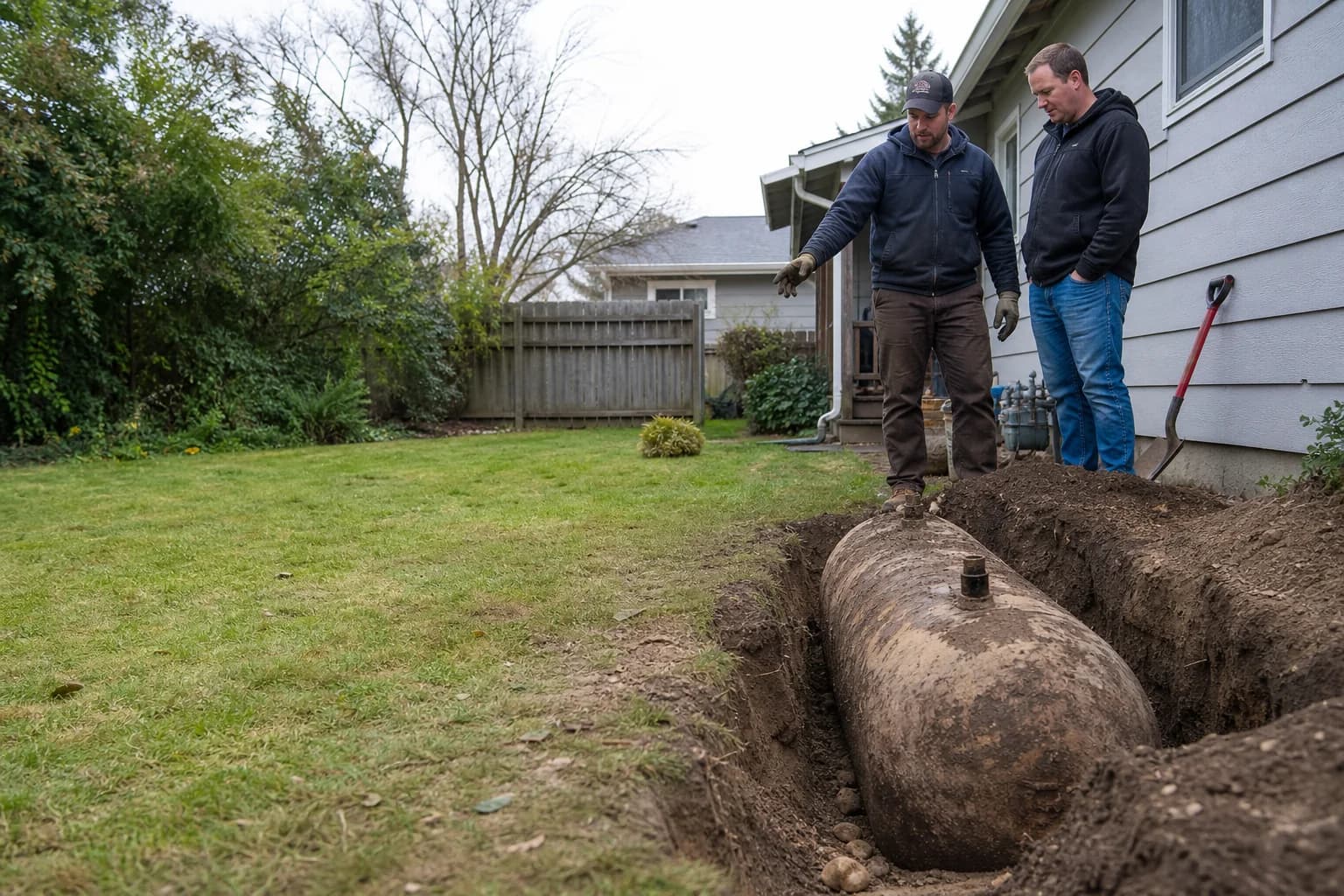
A minority of Salem-area underground heating oil tank decommissionings end as abandonment in place rather than removal. It comes up more here than in some other Willamette Valley markets because Salem's mid-century building patterns put a lot of tanks under driveway extensions added in the 1960s and 1970s, and Salem-Polk soils plus capitol-district mature canopy create constrained-access pits where removal would damage permanent structures.
Oregon DEQ recognises both paths as valid decommissioning. Same Decommissioning Report at the end, same DEQ HOT Program filing, same soil-sampling protocol. The choice is not "do the work the right way vs do it cheap"; it is "remove vs leave in place, given the specific obstacle at this lot." This guide walks through the decision honestly: when abandonment is the right call, when removal is the only defensible answer, what the Salem cost difference actually looks like in 2026, and how each path plays when the house goes to market.
For the broader process around either path, the Salem oil tank removal pillar covers the routine workflow. For what happens when sampling reveals contamination on either path, Salem soil contamination and DEQ cleanup covers the release side. The abandonment-in-place service page walks the technical workflow.
// In this guide
- 01What OAR 340-177 actually says about the two paths
- 02The five scenarios where abandonment is genuinely the right call in Salem
- 03The five scenarios where removal is the only defensible choice
- 04What the cost difference actually looks like in Salem 2026
- 05Soil samples: same protocol, different access geometry
- 06How the choice plays at resale in the Salem market
- 07The Salem permitting picture: City of Salem, Marion, and Polk County
- 08Common Salem homeowner mistakes on this decision
What OAR 340-177 actually says about the two paths
Oregon's Heating Oil Tank rule, codified at OAR 340-177, gives a licensed service provider two routes to close out an out-of-service residential underground heating oil tank. Both end at the same place. A certified Decommissioning Report submitted to DEQ, a registration letter against the property, soil samples in hand. The difference is what happens to the steel and the pit.
- 01Removal. Excavate the pit, pump and clean the tank, cut the steel into manageable pieces, lift out, haul to a certified scrap recycler. The pit is now fully visible: any contamination is obvious, soil samples are pulled from clean walls and floor, the pit is backfilled with clean fill compacted in lifts. DEQ's preferred default, and where most Salem-area UST decommissionings end up.
- 02Abandonment in place (AIP). Pump and clean the tank through an access port without excavating the pit, fill the empty tank with sand or controlled low-strength material (CLSM, basically lean concrete) so it cannot collapse, cap the openings. Soil samples are pulled through boreholes adjacent to the tank rather than from an open pit. The tank stays in the ground forever; the steel will eventually corrode but the fill keeps the void from collapsing.
- 03Both produce a Decommissioning Report. Same sampling panel (TPH-Dx and BTEX), same ORELAP-accredited lab, same 60-day filing deadline. DEQ records "removal" or "abandonment in place" against the property; both close the regulatory file equally.
- 04DEQ does not let you choose abandonment to save money. Abandonment is allowed when removal would damage permanent structures. It is not a budget option for a clean removal case. A licensed Salem provider who proposes AIP without a structural justification is cutting corners; DEQ Western Region knows the providers who do this and the Decommissioning Reports they file get extra scrutiny.
Watch out
Watch the wording on the proposal. A licensed Salem provider should explicitly state the structural reason AIP applies to your tank: which permanent structure removal would damage, why excavation around it is impractical, and what the alternative would cost. A proposal that just says "we recommend abandonment in place" without that justification is one that will produce a thin Decommissioning Report and a less marketable property record.
The five scenarios where abandonment is genuinely the right call in Salem
Five typical Salem-area situations make abandonment in place the structurally correct path rather than a corner-cut. If your lot fits one of these, AIP is what a careful licensed provider will recommend.
- 01Tank under a permanent driveway extension or garage slab. Common pattern on 1955 to 1975 Salem homes where the original garage was extended over what used to be open yard. The buried tank now sits under five to twelve inches of concrete plus a driveway slab the homeowner does not want to demolish. Removal would mean cutting the concrete and re-pouring, $4,000 to $8,000 of demolition and replacement work on top of the decommissioning. AIP avoids the concrete impact entirely.
- 02Tank within excavation-clearance distance of a foundation footing. Older Highland, Englewood, and South Central Salem homes (1925 to 1955) often have tanks placed three to six feet from the side or front foundation. Open excavation that close requires structural shoring or risks undermining the footing in clay-heavy Marion County soils. A licensed provider will choose AIP rather than risk a foundation crack the homeowner would later attribute to the work.
- 03Tank under a mature street tree or City of Salem-protected tree. Salem's tree canopy is regulated through the City of Salem Tree Preservation ordinance and the Urban Forestry permit process. Removal that requires cutting roots inside a tree's critical root zone (typically a circle one foot in radius per inch of trunk diameter) may not be permitted, or may require a separate arborist report. Common on tree-lined streets in Court-Chemeketa, Northeast, and Grant Neighborhood. AIP preserves the tree.
- 04Tank in West Salem with utility easement complications. West Salem sits in Polk County; the underlying utility easement pattern differs from City of Salem proper. Tanks placed in easements that the homeowner does not technically control (or that have buried utilities the homeowner did not know about) make open excavation a coordination nightmare. AIP, with proper utility-locate clearance, avoids the easement issue.
- 05Tank in a basement or partial-basement crawl space where access geometry blocks removal. Some older Salem homes have basement-stairwell geometry that physically prevents getting a 275-gallon oval tank out in one piece without cutting through floor joists or wall framing. Cutting the tank in place inside the basement, capping the openings, and filling the void with CLSM is the AIP path. Common on Yew Park and South Central pre-1940 homes.
The five scenarios where removal is the only defensible choice
Conversely, certain Salem-area situations make removal essentially mandatory. If you fit one of these, a licensed provider proposing AIP is the wrong provider for the job.
- 01Active or suspected leak. Once a release is on the table, the pit has to be opened to characterize the extent. AIP at a suspected-release site closes off any future ability to verify the contamination boundary without re-excavating, which would defeat the purpose. DEQ Western Region will reject AIP for any tank with field-screen indicators of a release.
- 02Real-estate transaction where the buyer or lender requires removal. Some Salem-area buyers — especially out-of-state cash buyers and FHA-backed loans — explicitly require removal rather than abandonment as a closing condition. The DEQ database entry for "removal" reads cleaner to a non-Oregonian buyer than "abandonment in place"; the savings on AIP are wiped out by the lost transaction.
- 03Tank in an open yard with clear access and no structural conflict. If removal is mechanically straightforward, AIP is hard to justify under OAR 340-177. The structural-justification requirement bites here: a licensed provider proposing AIP for an open-yard tank with five feet of clearance on every side is making a thin DEQ case.
- 04Property in a Salem flood zone or shallow-groundwater corridor. Parts of West Salem (near the Willamette), Northeast Salem (along Mill Creek), and the river-bottom strips have shallow groundwater and FEMA flood-zone designations. AIP in shallow groundwater raises long-term integrity questions even with CLSM fill; insurers and future buyers will both ask questions. Removal eliminates the variable.
- 05Tank with documented prior repair patches. A tank with documented prior leak repairs (patches, sleeve liners) is also a removal case because the structural integrity assumption underlying AIP fill no longer holds.
Note
When in doubt, remove. AIP is the right answer when removal is genuinely impractical; the rest of the time, removal produces the cleanest property record, the most marketable DEQ database entry, and the fewest future questions. The savings on AIP are real but rarely large enough to outweigh the resale friction.
What the cost difference actually looks like in Salem 2026
AIP saves money but less than most homeowners assume. The savings come from skipping excavation labor and equipment time, but most of the cost in a decommissioning is permit, pump-and-clean, sampling, lab fees, disposal, and Decommissioning Report drafting — none of which AIP avoids. Salem-area 2026 ranges:
- 01Clean underground tank removal (Salem): $1,400 to $3,500. Standard case. Permit, locate, excavate, pump and clean, cut and remove, soil samples, backfill with clean fill, ORELAP lab fees, Decommissioning Report. Steel goes to a certified scrap recycler.
- 02Clean abandonment in place (Salem): typically $1,100 to $3,800. Permit, locate, pump and clean through access port, soil samples through boreholes, CLSM fill, cap openings, Decommissioning Report. Usually somewhat cheaper than full removal, though a constrained pit needing extra documentation can close the gap.
- 03AIP with structural constraint adder (Salem): $1,500 to $2,800. AIP cases that require additional engineering documentation, deeper boreholes around obstructions, or larger CLSM volumes for tanks over 500 gallons. The "saved" money on excavation gets eaten by the additional documentation.
- 04Removal with concrete demolition adder (Salem): $4,000 to $8,500. When removal requires cutting and replacing a driveway slab or garage extension. This is exactly the case where AIP is the structurally correct choice; the demo adder makes the cost gap between paths visible.
- 05CLSM fill material (Coffin Butte sand alternative): $200 to $450 added. Most Salem providers use sand for typical 275-gallon AIP fills; controlled low-strength material (lean concrete mix) is used for larger tanks or where future settlement is a concern. CLSM is sourced from regional concrete plants; Coffin Butte-area aggregate sources are the typical supply for Marion County jobs.
Tip
If a Salem provider quotes AIP at the same price as removal, they are not actually saving you money. Conversely, if a provider quotes AIP at half the cost of removal, that quote almost certainly skips required steps. The honest cost gap on a 275-gallon Salem UST is $300 to $600. Anything outside that range warrants questions.
Soil samples: same protocol, different access geometry
One persistent misconception in the Salem market is that abandonment in place lets you skip the soil testing. It does not. OAR 340-177 requires the same TPH-Dx and BTEX panel from the tank pit area regardless of which path is chosen. The difference is how the samples are pulled.
- 01Removal sampling. Two to four samples pulled directly from the open pit: typically one beneath each end of the tank footprint, one at the deepest point, one stockpile sample if any excavation soil was set aside. The licensed provider has direct visual access to the pit; if visual indicators suggest contamination, additional samples can be added in real time.
- 02AIP sampling. Two to four samples pulled through dedicated boreholes around the tank, drilled with a Geoprobe or hand auger to a depth equivalent to the tank footprint. Sample locations are diagrammed against the (unexcavated) tank position. Same lab panel, same screening thresholds.
- 03The risk of missing contamination is slightly higher with AIP boreholes. Open pit sampling lets the crew see the contamination plume; borehole sampling samples specific locations and may miss localised hot spots between borings. Most experienced Salem providers compensate by pulling more boreholes (5 to 6) rather than 2 to 3, especially on pre-1965 tanks with higher base-rate failure risk.
- 04If samples come back over the cleanup level on AIP, the file becomes a Cleanup Rule case anyway. AIP does not protect against a release call; it just changes the access pattern for confirming it. Contamination above DEQ residential cleanup levels triggers the same characterization, excavation, and Cleanup Report workflow regardless of the original path. See Salem soil contamination and DEQ cleanup for the cleanup workflow.
How the choice plays at resale in the Salem market
The DEQ Heating Oil Tank database is public and searchable by address. Both "removal" and "abandonment in place" entries close the property's file equally as a regulatory matter, but they read differently to buyers, inspectors, and lenders. The practical Salem-area resale picture:
- 01Removal reads cleanest. The database entry says "removed", samples were clean, the tank steel is gone. Most Salem-area title insurance reads it as a closed matter without further commentary. State-employee buyers (a large share of Salem buying volume) tend to be detail-oriented and prefer the cleaner entry.
- 02AIP raises future-buyer questions. The database entry says "abandoned in place", meaning the tank is still buried but filled. Some inspectors flag this in their reports; some buyers ask for documentation; some lenders ask for additional environmental review. None of these are deal-breakers, but they add friction.
- 03Lender behavior varies. Many lenders accept AIP once the Decommissioning Report is on file, but underwriters differ and it is worth confirming early. FHA-backed loans sometimes ask for additional documentation. Out-of-state cash buyers (Bay Area and Seattle relocations are a real share of Salem volume in 2024-2026) frequently prefer the removed-entry properties without explicitly excluding AIP.
- 04The Decommissioning Report itself is the key document. Whichever path you choose, the Report is what the buyer's lender and title insurance will ask for. Make sure the licensed provider files it with DEQ within the 60-day window and gives you a copy for the property file. A properly filed Report essentially equalises the two paths in most Salem transactions.
Tip
If you are planning to sell within five years and the cost differential between paths is $300 to $600, choose removal. The marginal resale clarity is worth more than the marginal savings. If you are staying long-term and AIP is the structurally correct path, AIP is fine; the resale concern is largely speculative at a 10+ year horizon.
The Salem permitting picture: City of Salem, Marion, and Polk County
Salem-area decommissioning permits go through one of three jurisdictions depending on where the property sits. Cost is similar across all three; the documentation requirements differ. A licensed provider familiar with Salem-area work navigates this without homeowner involvement, but it helps to know the structure.
- 01City of Salem (most addresses). Permit issued through City of Salem Permit Application Center. Typical turnaround 5 to 10 business days for a standard decommissioning. Both removal and AIP use the same permit. Driveway-cut work (when removal requires opening concrete) may require a separate right-of-way permit if any cut extends into the public ROW.
- 02Marion County unincorporated (outside city limits). Permit through Marion County Public Works. Slightly longer turnaround (7 to 14 business days) because the county processes fewer of these. Same fee structure as City of Salem essentially.
- 03Polk County (West Salem and rural west-side). West Salem properties sit in Polk County, which uses a separate permit system through Polk County Public Works. Polk County turnaround is typically 7 to 12 business days. Some West Salem providers maintain Polk County contractor registration separately from Marion County; verify your licensed provider holds both if your property is in West Salem.
- 04Tree-canopy properties: City of Salem Urban Forestry overlay. If excavation extends into a regulated tree's critical root zone, a separate Urban Forestry permit applies. This is the case where AIP is often the simpler path; preserving the tree avoids the additional permitting layer entirely.
Common Salem homeowner mistakes on this decision
Five patterns the local licensed-provider community sees repeatedly in Salem-area decommissionings:
- 01Choosing AIP to save money on a clean-access tank. Most common mistake. The structural-justification requirement makes this a thin DEQ case, the savings are $300 to $600, and the database entry is permanently less marketable. Remove if access is clear.
- 02Choosing removal to maximise resale clarity on a structurally constrained tank. Less common but more expensive. Removing a tank under a driveway extension turns a $2,500 job into a $7,500 job; the marginal resale clarity rarely justifies the spend.
- 03Not getting AIP justification in writing. A licensed provider should document the specific structural reason AIP was chosen in the Decommissioning Report. Without that documentation, a future buyer or inspector reading the Report just sees "AIP" without the why, which raises questions that would not exist with documentation.
- 04Picking the wrong provider for the path. Some Salem providers do removals well but cut corners on AIP boreholes; others do AIP well but lack the heavy-equipment capacity for tight-access removals. Match the provider to the path.
- 05Treating AIP as faster. AIP and removal both take 1 to 2 working days on site; the timeline-driver is permit issuance (5 to 14 days) and lab turnaround (7 to 21 days), neither of which changes between paths.
Ready to schedule a Salem-area decommissioning?
Free site survey, fixed-price written quote, full DEQ closeout documentation. Most surveys scheduled within 48 hours.
Request a Written QuoteMore Salem guides on this topic
Decision Guide: Common Questions
My tank is in an open yard with clear access. Can I still choose AIP to save money?
I am in West Salem (Polk County). Does the path decision change?
Does AIP affect homeowner insurance?
How long does each path take in Salem?
Will the buried tank cause future problems if I abandon it in place?
What if I am converting to natural gas with NW Natural — does that change the choice?
Does the City of Salem ever require one path over the other?
My provider quoted both options at the same price. Is that a red flag?
Related services and references
Service
Oil Tank Abandonment in Place
Technical workflow for AIP: pump, clean, sample, fill, cap, file Decommissioning Report.
Service
Underground Oil Tank Removal
Full UST decommissioning: excavate, pump, cut, remove, sample, backfill, file Report.
Guide
Oil Tank Removal Salem Pillar
The master decommissioning hub: when removal is required, what the work involves, what it costs.
Guide
Oil Tank Soil Contamination Salem
What happens when soil samples come back over the cleanup level on either path.
Guide
Oregon DEQ Oil Tank Rules
OAR 340-177 in plain English: the framework behind the decision.
Guide
Oil Tank Removal Cost in Salem
Detailed 2026 Salem pricing for both removal and abandonment scopes.