
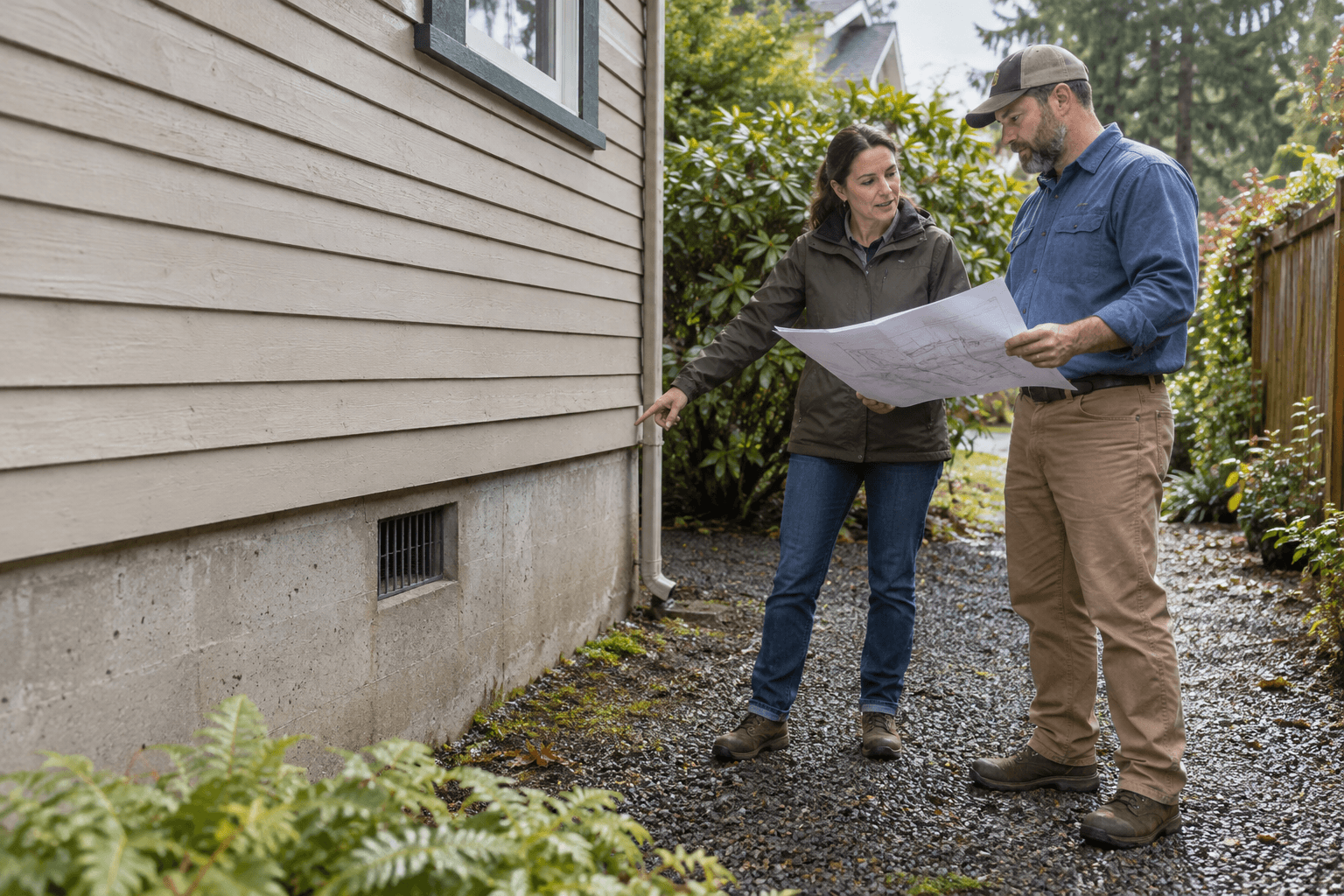
An oil tank leak beneath a Salem home needs a cleanup plan that accounts for both the contamination and the building above it. Start by asking your licensed heating oil tank provider to identify the access problem and the specialists needed to resolve it. A foundation, garage slab or addition can change the proposed work. It does not, on its own, establish that the crew must remove the building or may leave the contamination untouched.
This planning starts after the team has addressed any immediate release. For the earlier investigation sequence, read our contamination next steps article. Once the building limits access, your priority is to agree on who investigates the ground, who evaluates structural effects and who coordinates the proposed approach with DEQ.
Put the building and contamination on the same drawing
Ask for a drawing that relates the investigation to the house. The consultant should distinguish confirmed findings from areas they have not assessed. A note saying soil remains under the garage tells you little unless you can locate that area relative to the samples, slab and foundation. Keep the drawing with the laboratory reports rather than relying on a contractor's verbal description.
EPA's contaminated soil excavation guide explains that investigation precedes excavation and that buildings can limit access and equipment choices. That national overview supplies background; your provider must determine what works at your property under Oregon's cleanup requirements. Ask them to identify the evidence they still need before recommending an approach.
- Mark the known tank or former tank position, sample locations and areas where the team found contamination.
- Show the house outline, garage or addition, and the access route the contractor proposes to use.
- Separate measured locations from approximate positions reconstructed from old photographs or recollections.
- List unanswered questions beside the drawing, with a named person responsible for resolving each one.
Give the consultant any plans from earlier additions or foundation repairs. State whether those plans reflect the current building. You can help by gathering records and describing changes, but leave confirmation of underground conditions and structural details to the professionals. Ask them to date each revision so everyone prices and discusses the same version.
// Featured service
Soil Testing & Contamination Cleanup
Soil testing to find out whether a heating oil tank leaked, and cleanup when it did. Samples go to an accredited lab for diesel-range hydrocarbons; a confirmed release is reported to DEQ and cleaned up under the route the site qualifies for, through to a closed DEQ file.
Agree on structural review before expanding the dig
The environmental consultant and the person reviewing the structure need to exchange their findings. A proposed investigation location may raise a building-support question; a structural constraint may require the consultant to reconsider access. Ask the project lead to arrange that discussion before separate contractors arrive with incompatible scopes.
OSHA's adjacent structure requirements address support when excavation threatens adjoining buildings and restrictions on work below foundations that could endanger employees. Oregon OSHA includes these provisions in its excavation rules. They are worker-protection requirements, not a set of homeowner digging instructions. Have the contractor explain who evaluates the proposed work and when a structural engineer must participate.
Before accepting the next work phase, request a written explanation of the proposed access, any structural assessment and the conditions that would make the crew pause. Include responsibility for checking permits and inspections with the building authority. Do not treat a cleanup discussion with DEQ as a substitute for those separate checks. Keep yourself, children and pets out of the contractor's work area.
Ask whether DEQ needs closer involvement
DEQ's Heating Oil Tank Cleanup Agreement page identifies buildings that prevent soil removal as one example of a complex site. It also describes sites involving protective systems, monitoring or use restrictions. DEQ staff work with the licensed provider to determine whether a Cleanup Agreement is appropriate. Signing the agreement is voluntary; completing the necessary cleanup remains an obligation.
DEQ says a provider may recommend an environmental consulting firm for a complex cleanup, and the licensed provider still certifies its work. Depending on site conditions, DEQ may issue a conditional no-further-action letter, including where a protective system needs operation and maintenance. Ask your provider what outcome they propose for your site and what evidence the agency needs to consider it.
Use one named contact for agency correspondence. Ask that person to keep a dated record of submissions, questions and responses, and send you copies. If a discussion produces a new task, add its owner and due date to the project list. An unanswered question about the plan should remain visible until someone resolves it.
Assign the decisions before authorizing the work
Use this responsibility register at the planning meeting. Replace role names with actual people, record their contact details and ask each person to confirm their scope. One company may cover several roles, while another project may need separate firms. The register helps organize the conversation; the contracts and applicable requirements determine each party's duties.
- Environmental consultant: identify the investigation questions, explain the proposed cleanup approach and list any unresolved exposure or access concerns. Request a dated plan and the findings supporting it.
- Structural professional: evaluate the building questions within their agreed scope and explain any conditions affecting the proposed access or excavation. Identify the drawings or written findings the contractor needs.
- Licensed heating oil tank provider: confirm the fieldwork, certification and subcontracted tasks included in the proposal. Name the person who coordinates with the consultant and handles changes during the work.
- DEQ contact, if assigned: clarify the agency's involvement and outstanding submissions. Ask the project lead to distinguish agency feedback from the contractor's own recommendation.
- Homeowner: supply available records, arrange agreed access and identify who can authorize spending. Keep the current scope, decisions and reports together, and tell the team about planned building changes.
Finish the register with a handoff column. For each task, write who receives the result and what happens next. For example, the consultant may need a structural finding before finalizing the field scope. Recording that dependency gives you a better scheduling question than asking each contractor for an isolated completion date.
Separate the next phase from the whole cleanup budget
Ask the provider to separate confirmed work from allowances that depend on further findings. For each phase, request the deliverable, exclusions, price basis and approval point. Include the cost of additional professional review where it falls outside the quote. A proposal should explain whether it covers investigation, cleanup work, reporting or only one of those tasks.
Consider an illustrative planning problem: an owner receives a price for removing accessible soil beside a garage, but the consultant still needs to assess material beneath the slab. Before accepting the proposal as the complete cleanup budget, the owner asks who will investigate that area and how the next decision will affect the scope. This is a hypothetical example, not a completed Salem project or a cost estimate.
Keep a short change log during the work. Record the new finding, the recommended response, who reviewed it and your written authorization where required. Ask the provider to separate a scheduling delay from a change in the technical plan. For broader cleanup approaches, our soil cleanup guide provides the context; the project documents need to explain the choice for your house.
Keep air concerns and other findings in the project scope
Tell the consultant if your concern includes the air inside the home. Ask whether their scope addresses that question and whether another specialist needs to join the team. Our indoor air assessment guide explains the assessment conversation. Do not describe a structural review or removal of the metal tank as an indoor-air finding.
During progress calls, ask the lead consultant to identify any new issue outside the agreed investigation. Record the proposed referral, its purpose and the person responsible for arranging it. Give each professional the relevant reports so they can distinguish earlier findings from assumptions. You should not have to pass on technical conclusions from memory between firms.
Request a clear handoff when fieldwork ends
Before the contractors demobilize, arrange a handoff meeting. Request the updated site drawing, investigation and work reports, agency correspondence, outstanding tasks and named follow-up contacts. Ask the consultant to distinguish work completed on the ground from any remaining reporting or agency steps. Keep estimates and draft reports separate from the final versions.
If the agreed approach includes a protective system, monitoring or a restriction, ask for the applicable site documents and an explanation of who takes responsibility next. Do not assume that every property has the same continuing requirements. This handoff should identify the actual conditions for your project, with a contact for questions before later building work.
For a soil testing and cleanup inquiry in Salem, explain that the suspected or confirmed contamination extends beneath a structure. Share the reports and describe the access constraint. Request a coordinated scope that names the environmental lead, addresses structural review and identifies the next decision you need to make.