
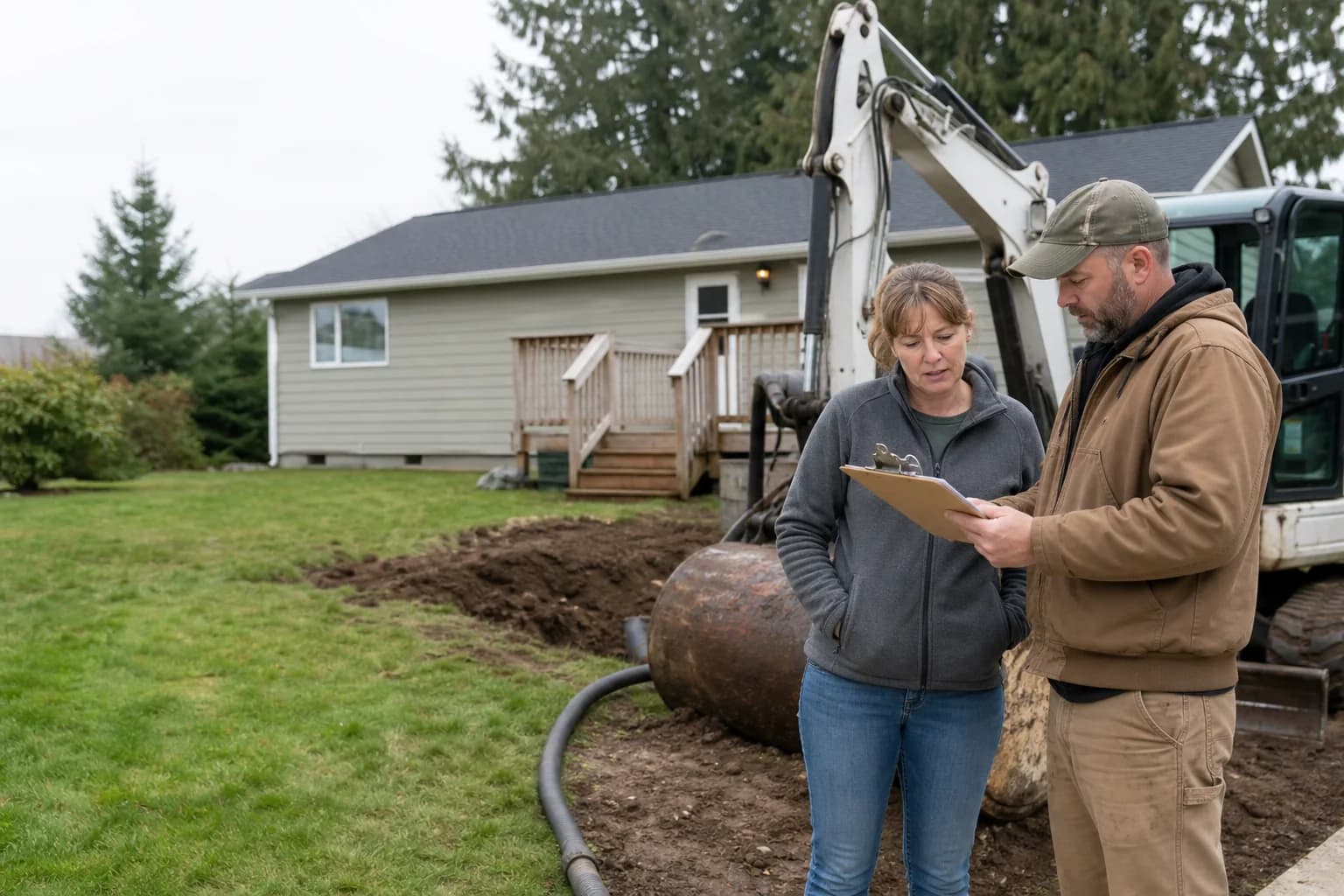
A standard underground heating oil tank decommissioning in Salem runs $1,400 to $3,500 when soil samples come back clean. Add localized contamination cleanup and the number climbs to $5,000 to $15,000. A full DEQ Cleanup Rule case with off-site disposal and groundwater monitoring runs $15,000 to $50,000+. These ranges reflect actual 2026 quotes from DEQ-licensed providers working inside the 97301-97309 corridor.
The reason quotes vary so much is that price depends on what the soil samples show, and you do not know what the soil samples will show until the tank is out. Honest providers quote the clean-decommissioning price plus a clearly-stated contamination contingency. Cheaper "starting from" quotes usually leave the lab fees, disposal manifests, and Decommissioning Report off the base number and add them at invoice time.
This guide breaks the cost down by scenario so you can read a quote intelligently and spot the missing line items. For the full process behind the pricing, see the complete decommissioning guide.
// In this guide
- 01The honest cost ranges for Salem in 2026
- 02What drives Salem-area pricing up or down
- 03Underground tank cost breakdown, line by line
- 04Aboveground tank removal cost in Salem
- 05Soil sampling and lab fees: where the surprises hide
- 06When soil samples come back hot: contamination cost tiers
- 07Budgeting a cleanup when the cost is yours
- 08How to compare estimates and spot the missing line items
The honest cost ranges for Salem in 2026
Here are the 2026 ranges. These reflect quotes from DEQ-licensed providers working in the 97301 to 97309 corridor; rates outside the Salem-Keizer metro run different.
- 01Underground tank, clean decommissioning, full removal: $1,400 to $3,500. Most common Salem scenario. Includes permit, locate, excavation, pump/clean, cut/remove, 2 soil samples, backfill, ORELAP lab fees, Decommissioning Report.
- 02Underground tank, clean decommissioning, abandonment in place: typically $1,100 to $3,800. Tank stays in the ground after pump/clean/fill. Used when removal would damage structures.
- 03Aboveground tank, exterior: $700 to $1,400. Disconnect, pump, cut, recycle. No excavation but DEQ still requires residual product manifest.
- 04Basement or crawl-space tank: $900 to $1,800. Pump, clean, cut in place, remove through stairwells or doorways.
- 05Localized contamination cleanup adder: $3,500 to $12,000. Additional excavation, off-site soil disposal, confirmation samples, supplemental report.
- 06Full DEQ Cleanup Rule case: typically $15,000 to $80,000+. Site characterization, possible groundwater monitoring, Cleanup Report, DEQ No Further Action letter. The owner carries this cost; the spread within the range comes down to whether the site meets DEQ's generic remedy conditions.
Note
A clean decommissioning is the most common outcome. Most Salem-area underground tank decommissionings end with clean soil samples and no cleanup adder. A minority need at least localized cleanup, which is the scenario the tiers below cover.
What drives Salem-area pricing up or down
Six factors set the actual quote a Salem homeowner gets. Knowing which ones apply to your property tells you whether you should expect the low or high end of the range.
- 01Tank size and depth. A 250-gallon tank buried 3 feet deep on a flat side yard is the easy case. A 1,000-gallon tank under 5 feet of cover, with a tree close to the pit, runs noticeably more. Most Salem tanks are 250 to 500 gallons buried 2 to 4 feet deep.
- 02Equipment access. Crews need to bring a mini-excavator, vacuum truck, and dump trailer to within working distance of the tank. Narrow side-yard access (under 6 feet between house and fence) sometimes means manual digging and adds $300 to $600. No vehicle access at all (the West Salem hillside lots, certain South Salem properties) can push removal to abandonment-only.
- 03Surface restoration. Sod backfill is included in most base quotes. Restoring a poured concrete driveway, paver patio, or established landscaping (mature shrubs, irrigation lines) runs $400 to $1,500 on top.
- 04Permit jurisdiction. Which office issues it depends on where the parcel sits: the City of Salem inside city limits, Marion or Polk County outside them. Fees and turnaround are set locally and change, so we confirm the current figure with the issuing office rather than quoting one from memory.
- 05Lab and disposal fees. ORELAP-accredited lab analysis for TPH-Dx plus BTEX is charged per sample, and tank steel recycling and residual fuel and sludge handling are charged by weight and volume. These should be included in the base quote, not added later.
- 06Season and crew availability. Peak demand in Salem is February through May (escrow season) and August through October (pre-winter conversion push). Off-season work in the mid-November to mid-January window sometimes prices a little softer, weather permitting.
Underground tank cost breakdown, line by line
A typical $1,900 underground tank decommissioning in Salem breaks down roughly as follows. Use this to read your quote: any missing line items mean the price will climb at invoice.
- 01Permit (City of Salem or Marion/Polk County). Set by the issuing office and itemized in any honest quote rather than buried in a total.
- 02Utility locate (Call 811): $0. Free state program but requires 48-hour notice. A licensed provider handles this.
- 03Excavation and tank exposure: $400 to $700. Mini-excavator on site for half a day. The biggest single line item.
- 04Pump and clean: $250 to $400. Vacuum truck for the residual fuel and sludge. Cost varies with how much fuel remains.
- 05Cut and remove tank steel: $200 to $350. Non-sparking saw, lift to dump trailer, transport to certified recycler.
- 06Soil sampling: $250 to $450. Two or three samples per DEQ protocol, ORELAP lab fees, chain of custody, turnaround.
- 07Backfill and compaction: $250 to $400. Clean fill placed in lifts, compacted to grade, surface restoration.
- 08Decommissioning Report: $150 to $300. Drafting, photo documentation, DEQ filing.
That totals roughly $1,650 to $2,850 for a clean decommissioning, matching the published range. If a quote comes in below $1,400 for a buried tank, ask which line items are missing. The most commonly omitted: lab fees (added as a "pass-through" on the invoice), Decommissioning Report drafting fee, and surface restoration.
Aboveground tank removal cost in Salem
Aboveground tanks (exterior, basement, crawl-space) skip the excavation step, which saves $400 to $700. But DEQ still requires the residual product to be handled by a licensed transporter, the steel to be recycled with documentation, and a decommissioning record kept for the property file.
- 01Exterior aboveground (oval on legs, side of house): $700 to $1,400. Disconnect supply line, pump residual fuel, cut steel into manageable pieces, haul off, recycle. 2 to 4 hours on site.
- 02Basement tank (oval, against foundation wall): $900 to $1,800. Same scope plus removal through a doorway or up a stairwell. Sometimes the tank gets cut into smaller pieces in place to fit through openings.
- 03Crawl-space tank: $1,000 to $2,000. Most labor-intensive of the three. Limited working room, sometimes requires cutting access from above.
Tip
Aboveground tanks do not require a Decommissioning Report under OAR 340-177 because they are not USTs. But lenders, buyers, and title companies often still want documentation that the work was performed by a licensed contractor. Always ask the provider to give you a written record of the decommissioning even when DEQ does not require one.
Soil sampling and lab fees: where the surprises hide
Soil sampling is the line item that cheaper quotes most commonly leave out. The samples themselves are required by DEQ; the labs that analyze them are required to be ORELAP-accredited; and the fees are real. A typical Salem decommissioning runs $250 to $450 in lab work for the soil testing alone.
Here is what the sampling actually costs:
- 01Sample collection labor: $50 to $100 per sample. Crew pulls the sample, fills the lab bottles, labels and bags, completes chain of custody.
- 02TPH-Dx analysis (per sample): $60 to $90. Total petroleum hydrocarbons in the diesel range (C10 to C24). The primary screening test for heating oil.
- 03BTEX analysis (per sample): $40 to $70. Benzene, toluene, ethylbenzene, xylenes. Benzene is the regulator-priority constituent.
- 04PAH analysis if requested (per sample): $80 to $150. Polycyclic aromatic hydrocarbons. Required only when older heating oil or weathered contamination is suspected.
- 05Lab turnaround: typically 5 to 14 business days standard, with rush available. Rush analysis carries a premium on the lab fees.
- 06Number of samples: 2 to 4 typical. DEQ guidance is one sample beneath each end of the tank footprint plus one stockpile sample when soil is being removed.
When soil samples come back hot: contamination cost tiers
A minority of Salem-area underground tank decommissionings return at least one soil sample above DEQ residential cleanup levels. Where that happens, most jobs land in one of three tiers. Treat the ranges as indicative; the actual number varies with access, depth, and how far the contamination has spread.
- 01Tier 1: localized exceedance, single area, shallow. Typically $3,500 to $12,000. One or two samples over the limit. Crew returns, excavates the affected area, samples the new excavation boundary, repeats until below screening levels. Soil disposed at a permitted facility. Supplemental Decommissioning Report. Most common contamination scenario.
- 02Tier 2: multi-zone exceedance or moderate depth. Typically $8,000 to $30,000. Contamination extends beyond the immediate tank pit or below 4 to 6 feet. Larger excavation footprint, more disposal volume, additional confirmation rounds, possibly site characterization borings.
- 03Tier 3: full Cleanup Rule case with groundwater. Typically $20,000 to $80,000+. Contamination has reached groundwater or migrated significantly horizontally. Site characterization, monitoring well installation, Cleanup Report, DEQ No Further Action determination. Groundwater impact disqualifies the site from DEQ's generic remedy, which is what pushes the cost into this band.
Watch out
If contamination is confirmed, do not panic but do not delay. Time matters: heating oil weathers and migrates over months, and a release that could have been a Tier 1 cleanup can become a Tier 2 if left for a full winter. Most cleanups end with a DEQ No Further Action letter; the cost is the question, not whether the file will close.
Budgeting a cleanup when the cost is yours
Plan on paying for it. Oregon runs no reimbursement fund for residential heating oil cleanup, and the responsibility sits with whoever owns the property at the time, regardless of who owned it when the tank actually leaked. That is the starting position for any realistic budget.
What you can influence is the pathway. DEQ's generic remedy closes a qualifying site without the site-specific risk characterization a full cleanup requires, and skipping that analysis is where the savings come from. Whether your site qualifies is decided by the laboratory, not by negotiation, but knowing the thresholds tells you early which budget you are working with.
- 01Disqualifiers are absolute. Groundwater impact, free product in the excavation, or ecological risk each rule out the generic remedy outright, whatever the concentrations look like.
- 02Concentration ceilings. Soil petroleum hydrocarbons at or below 10,000 ppm, with benzene analyzed separately and capped at 0.1 ppm.
- 03Cover and volume. At least three feet of clean soil over anything left in place, and no more than 65 cubic yards of remaining soil above 500 ppm. Volume is usually the constraint that decides a marginal Salem site.
- 04The alternative is not failure. A risk-based cleanup, using either DEQ-developed concentrations or a site-specific corrective action plan, reaches a legitimate closure. It simply costs more, because it buys the characterization the generic route avoids.
- 05Get the quote broken out. Excavation, disposal, lab work, and report preparation move independently. A single bottom-line figure hides which of them will grow if the samples come back worse than expected.
Tip
Ask a contamination quote which pathway it assumes and what the price becomes if the site is disqualified. The gap between those two numbers is the real financial risk you are carrying, and a provider who cannot answer has not thought about your budget.
How to compare estimates and spot the missing line items
Most Salem homeowners get two or three quotes before committing. Here is how to read them.
- 01Check for the DEQ license number. Active, in good standing, on the proposal. Verify against the DEQ Service Provider list. Unlicensed quotes will be cheaper for a reason: they do not produce a Decommissioning Report.
- 02Look for "fixed price" not "starting from." A licensed provider with Salem experience knows what the typical job costs. Open-ended quotes with "additional fees may apply" almost always end higher than the spread.
- 03Insist on a written soil-sample plan. Quote should specify: number of samples, locations relative to the tank, lab name (ORELAP-accredited only), analyte panel (TPH-Dx and BTEX at minimum), turnaround time.
- 04Permits in or extra? Salem-jurisdiction permits should be in the base quote, not an extra. Permits for properties outside Salem city limits (Marion or Polk County direct) may carry a small adder.
- 05Contamination contingency clearly stated. Honest quotes break out: base price (clean decommissioning), tier-1 contingency rate (per cubic yard of contaminated soil), tier-2 escalation rate. Quotes with no contingency disclosure usually surprise.
- 06Decommissioning Report drafting and DEQ filing included. Should be in the base, not a $200-$300 add-on.
- 07Surface restoration. Sod or gravel back to grade should be included. Concrete, pavers, or landscape restoration is reasonable to break out.
Ready to schedule a Salem-area decommissioning?
Free site survey, fixed-price written quote, full DEQ closeout documentation. Most surveys scheduled within 48 hours.
Request a Written QuoteMore Salem guides on this topic
Pricing: Common Questions
Why are quotes so different between contractors?
Can I get the work financed?
How much does it cost to find out if I have a buried tank?
My quote says "soil testing extra at lab cost." Is that a red flag?
Can I deduct any of this on my taxes?
How much for emergency or weekend service?
Are there any rebates or incentives that cover tank removal?
What is the absolute cheapest legitimate way to handle a Salem oil tank?
Related services and references
Guide
Complete Salem Oil Tank Removal Guide
The full decommissioning process end to end.
Guide
Oregon DEQ Oil Tank Rules
Why licensed providers cost more, and what you get for it.
Guide
Oil Tank Replacement & Gas Conversion
NW Natural and Energy Trust incentives that offset removal cost.
Service
Underground Oil Tank Removal
The most common Salem-area scope.
Service
Soil Testing & Contamination Cleanup
When samples come back hot and the cleanup pathway decides the cost.