
Almost every Salem homeowner who looks into decommissioning a heating oil tank runs into the same confusion: there seem to be two separate approvals, and nobody explains how they relate. There are. One is the local building permit that authorises the physical excavation, issued by the city or the county. The other is the DEQ Decommissioning Report that closes the file with the state. This page is about the first one.
The local permit is the smaller, faster piece, but skipping it or pulling it from the wrong jurisdiction stalls the job and can complicate a sale later. For the state side, the Oregon DEQ rules guide covers the Decommissioning Report; for the whole process end to end, start at the Salem oil tank removal pillar.
// In this guide
- 01The local permit and the DEQ filing are two different things
- 02Which office issues your permit: City of Salem, Marion, or Polk
- 03What the permit covers and what it costs in 2026
- 04The 811 utility locate before anyone digs
- 05The inspection and how the permit closes
- 06Who pulls the permit and where it sits in the schedule
The local permit and the DEQ filing are two different things
These get conflated constantly, so it is worth separating them cleanly before anything else. They are issued by different bodies, cost different amounts, and close at different times.
- 01The local building permit authorises the excavation and demolition work. It is issued by the City of Salem, Marion County, or Polk County depending on the address, and it triggers a site inspection at backfill. Fee is in the low hundreds.
- 02The DEQ Decommissioning Report is the state record that the tank was retired to OAR 340-177 standards. It is not a permit; it is a filing the licensed provider makes with DEQ after the soil results are in. It is what a future buyer's lender checks.
Note
You can have a local permit and still not have a compliant decommissioning, and vice versa. Both have to happen. The local permit covers the dig; the DEQ filing covers the closeout. A licensed provider handles both, but they are not the same document and they do not close on the same day.
Which office issues your permit: City of Salem, Marion, or Polk
Salem straddles the Willamette, and that river is also a county line. East-side Salem sits in Marion County; West Salem sits in Polk County. Inside city limits the City of Salem issues the permit regardless of county; outside city limits the county does. Your provider confirms the jurisdiction from the parcel before pulling anything.
- 01Inside Salem city limits (most addresses). Permit through the City of Salem Permit Application Center on Liberty Street SE. Same office whether the parcel is Marion or Polk side.
- 02Unincorporated Marion County. Properties outside the city limits on the east side go through Marion County Building Inspection.
- 03Unincorporated Polk County (rural West Salem and beyond). Polk County Community Development issues the permit for parcels outside city limits west of the river.
The practical reason this matters: fees and turnaround vary a little between the three, and the inspector who signs off comes from whichever office issued the permit. It does not change the actual work.
What the permit covers and what it costs in 2026
The permit covers the tank work specifically, not a blanket approval for anything else on the property. What it costs depends on the jurisdiction and on whether that office charges a flat decommissioning fee or scales by valuation, which is why a figure quoted for one Salem-area address does not reliably transfer to the next one.
- 01Covered: the excavation, the tank removal or in-place fill, and the backfill, with an inspection at the open pit or at backfill.
- 02Not covered: the DEQ Decommissioning Report, soil-lab fees, or any contamination cleanup if a release turns up. Those sit outside the building permit entirely.
- 03Add-ons: if the tank is under a structure and the work touches anything load-bearing, a separate structural review can apply. Rare on a standard side-yard tank.
The 811 utility locate before anyone digs
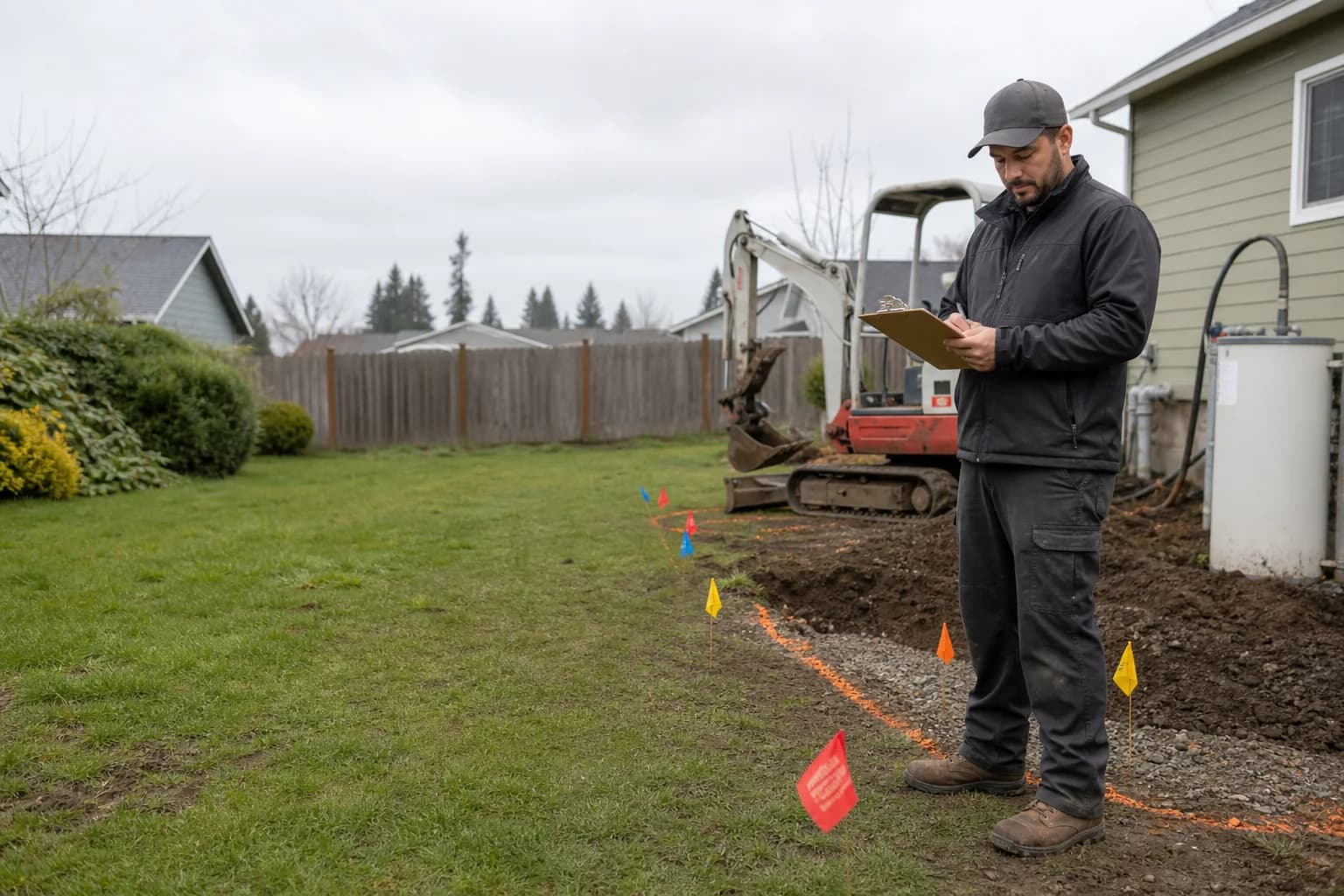
Independent of the building permit, Oregon law requires a utility locate before excavation. The provider files an 811 ticket, and the gas, water, power, and telecom utilities mark their lines in the work area. This is free and takes about two business days, but it is a hard gate: no responsible crew opens ground in a Salem yard without the locate marks down.
It matters more than it sounds on older Salem lots, where a 1950s tank sometimes sits close to an equally old gas service or an abandoned line that never got mapped. The locate is what keeps a routine dig from hitting a live service.
The inspection and how the permit closes
The issuing office sends an inspector to verify the work, almost always at the backfill stage while the pit is still open or freshly filled. The inspector confirms the tank was removed or properly abandoned, checks that the backfill is clean compacted material, and signs off the permit.
That sign-off closes the building permit. It does not close the DEQ side, the soil samples are still at the lab at that point, and the Decommissioning Report follows weeks later. So a finalised permit is a milestone, not the finish line.
Tip
Keep the finalised permit with the Decommissioning Report in your property file. When you sell, a buyer's agent or lender may ask for both: the permit shows the city signed off the work, the Report shows DEQ recognized the closeout. Having the pair ready heads off last-minute escrow questions.
Who pulls the permit and where it sits in the schedule
The licensed service provider pulls the permit, not the homeowner. You are the permit-holder of record, but you do not stand in line at the Permit Application Center. The provider builds the permit into the job timeline:
- 01Day 0: provider confirms jurisdiction, files the permit application and the 811 locate ticket.
- 02Days 3 to 10: permit issues (city turnaround is usually quicker than county) and locate marks go down.
- 03Work day: 1 to 2 days on site for the decommissioning, with the inspection at backfill.
- 04After: permit finalises on inspector sign-off; the DEQ Report files once lab results return.
If you are on an escrow clock, the permit turnaround is rarely the bottleneck; the soil-lab and DEQ stages are. See how long a Salem decommissioning takes for the full timeline, and verify your provider is licensed before any of this starts in choosing a licensed Salem contractor.
Ready to schedule a Salem-area decommissioning?
Free site survey, fixed-price written quote, full DEQ closeout documentation. Most surveys scheduled within 48 hours.
Request a Written QuoteMore Salem guides on this topic
Permits & Process: Common Questions
Do I pull the permit myself or does the contractor?
How much is the permit and how long does it take in Salem?
My house is in West Salem. Does that change the permit?
Is the building permit the same as the DEQ Decommissioning Report?
What happens if a previous owner did the work without a permit?
Related services and references
Guide
Complete Salem Oil Tank Removal Guide
The full decommissioning process this permit sits inside.
Guide
Oregon DEQ Oil Tank Rules
The state Decommissioning Report side, separate from the local permit.
Guide
How Long a Salem Decommissioning Takes
Where the permit fits in the overall timeline.
Guide
Oil Tank Removal Cost in Salem
How the permit fee fits into the total decommissioning bill.
Service
Underground Oil Tank Removal
The permitted excavation workflow end to end.