
Part of: Abandon or Remove Your Salem Oil Tank: 2026 Decision Guide
Salem driveways, patios and additions often went in long after the heating oil tank did, which is why so many tanks turn up under a hard surface. The good news is that Oregon treats both ways of closing the tank the same. Under OAR 340-177-0025, a tank can be decommissioned either by removing it or by filling it completely in place with a compacted inert solid material, and the rule sets no condition that removal must be impossible first.
So the question is practical rather than legal: what each route costs once the concrete is counted, how the soil gets tested if the tank stays put, and whether a buyer will accept it. If you are not yet sure where the tank sits, locating the buried tank first tells you how much of the surface is actually involved.
// In this guide
Filling a Tank in Place Under Concrete
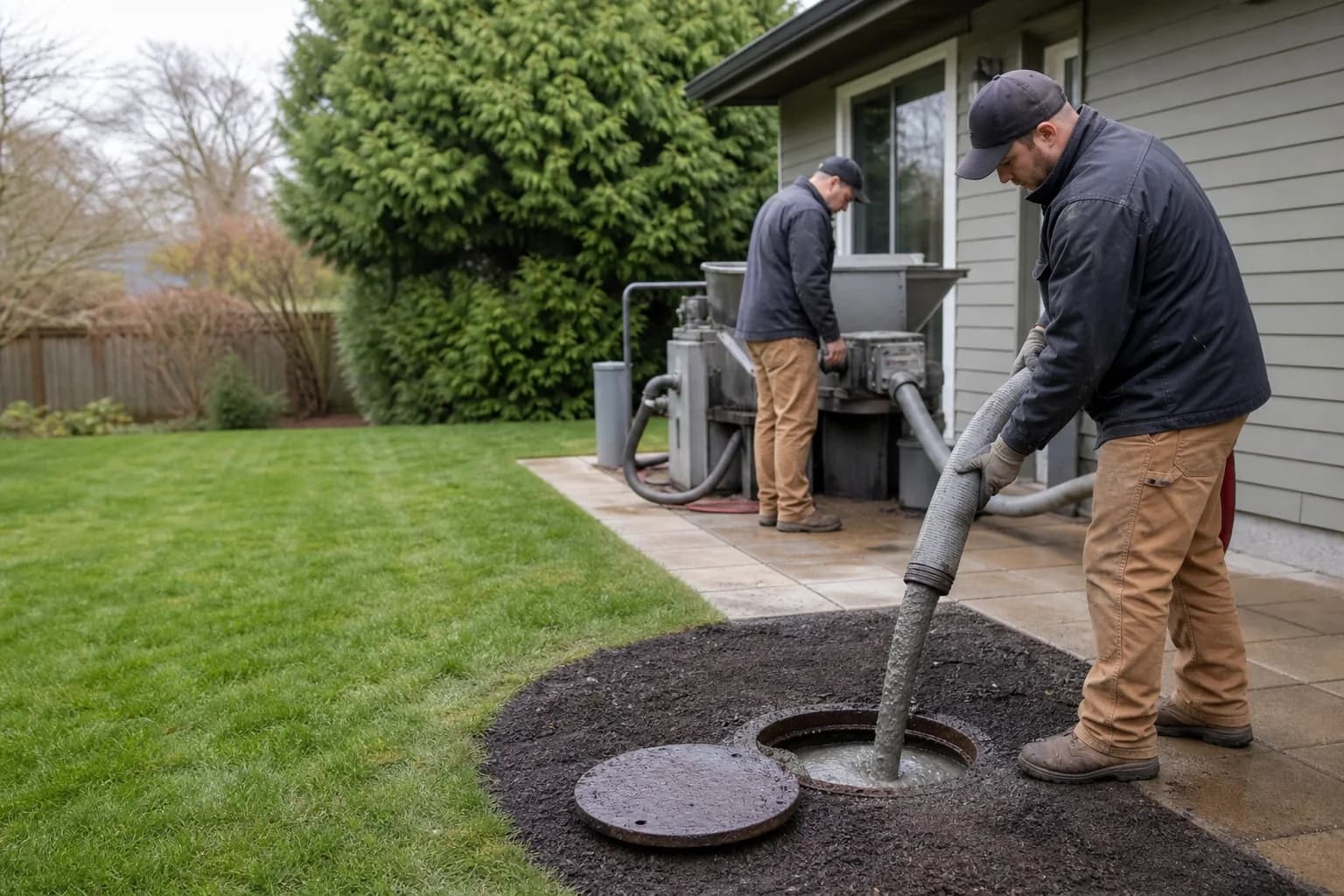
Filling in place is the route that leaves most of the surface intact. The residual oil and sludge are pumped out, the tank is cleaned, and it is filled with compacted inert material. DEQ’s decommissioning guidance for homeowners lists sand, pea gravel topped with a soil and water mud, or a concrete slurry mix, and then every opening, including the vent line, is plugged or capped.
Access is the catch. DEQ’s usual method exposes the top of the tank and cuts it open to clean and inspect the inside, so a section of driveway or patio over the tank still has to come up, just a much smaller one than a full removal needs.
Soil Testing When the Tank Stays in Place
The soil still has to be tested, and DEQ describes two ways to do it. The preferred method cuts at least two sampling holes into the bottom of the emptied tank, one at each end, plus one at any corrosion hole. Where site conditions prevent cutting into the tank, DEQ allows an alternative: three samples, one from the worst contamination found and two taken within six inches of each end of the tank, one to two feet below its bottom.
Under a driveway or slab, that alternative usually means drilling small holes through the surface beside each end of the tank. DEQ does not say how to get through the concrete, so ask your provider how they will reach the sampling points and what patching is included. The samples go to an accredited lab, and a result at or above 50 ppm turns the job into a reported cleanup.
Removing a Tank From Under a Driveway or Patio
Removal means saw-cutting and breaking out the section of surface over the tank, excavating, lifting the tank out, sampling the native soil below each end, and backfilling in compacted lifts before the surface is rebuilt. By DEQ’s description the tank is usually 46 inches across and four to eight feet long, so the patch is limited, but concrete and pavers have to be replaced on a properly compacted base or the repair will settle and crack.
Removal makes sense when the driveway is due for replacement anyway, when a buyer insists on it, or when a garage or addition is planned over the spot. It is also the route that leaves nothing in the ground to explain later, which is why underground oil tank removal remains the default for many owners who can live with the patch.
Which Route Suits Your Property
Most owners land on one of these four situations.
- 01Driveway in good condition, no building plans. Filling in place usually costs less and disturbs less.
- 02Driveway due for replacement anyway. Removal during the rebuild adds little and leaves nothing buried.
- 03Tank under an addition or garage slab. Filling in place is often the only practical choice, sampled beside the tank ends.
- 04Buyer or lender insists on removal. Remove it, or negotiate a credit so the buyer can do it after closing.
Either way, the certified report goes to DEQ with the $104 fee and DEQ sends a letter confirming it is registered, so a tank filled in place under a driveway carries the same paperwork as one that was dug out.
Why an Empty Tank Should Not Be Left Unfilled
Leaving a tank pumped but unfilled under a driveway is the one option to avoid. Steel keeps corroding, and a buried tank that rots through can collapse and leave a void or a sinkhole under whatever sits above it. It also leaves the tank legally emptied but not decommissioned, which a buyer will still want dealt with. Filling it with compacted material is what removes the collapse risk.
More owners are meeting this question at the point of conversion. Oregon’s Heat Pump Purchase Program has been drawing homes off oil since June 2025, and switching to another heat source triggers the legal duty to empty the tank anyway, so that is the natural moment to decide whether it gets filled or removed.
What a Tank Under Concrete Costs
The tank work itself is priced much like any other buried tank. Published Portland-area figures put decommissioning in place from about $1,000, and removal of a residential tank of 550 gallons or smaller at roughly $1,800 to $2,500. The hard surface is extra, and there is no reliable published Salem figure for it, so it should be quoted on site once the tank has been located and measured. The wider Salem oil tank removal cost ranges cover the rest of the job.
Ready to schedule a Salem-area decommissioning?
Free site survey, fixed-price written quote, full DEQ closeout documentation. Most surveys scheduled within 48 hours.
Request a Written Quote