
In Salem you can usually leave a heating oil tank in the ground, as long as a licensed provider empties it, cleans it, fills the void, and the soil samples come back clean under the Oregon DEQ Heating Oil Tank program. Decommissioning in place is a legal, compliant outcome here. What changes the answer is contamination, building plans, and what a buyer or lender will accept.
What decommissioning in place actually means
Leaving a tank in the ground is not the same as ignoring it. Under the Oregon DEQ Heating Oil Tank program, a heating oil tank can be decommissioned one of two ways: removed from the ground, or decommissioned in place. The in-place path keeps the steel where it is, but only after a defined set of steps that a licensed service provider has to complete and document.
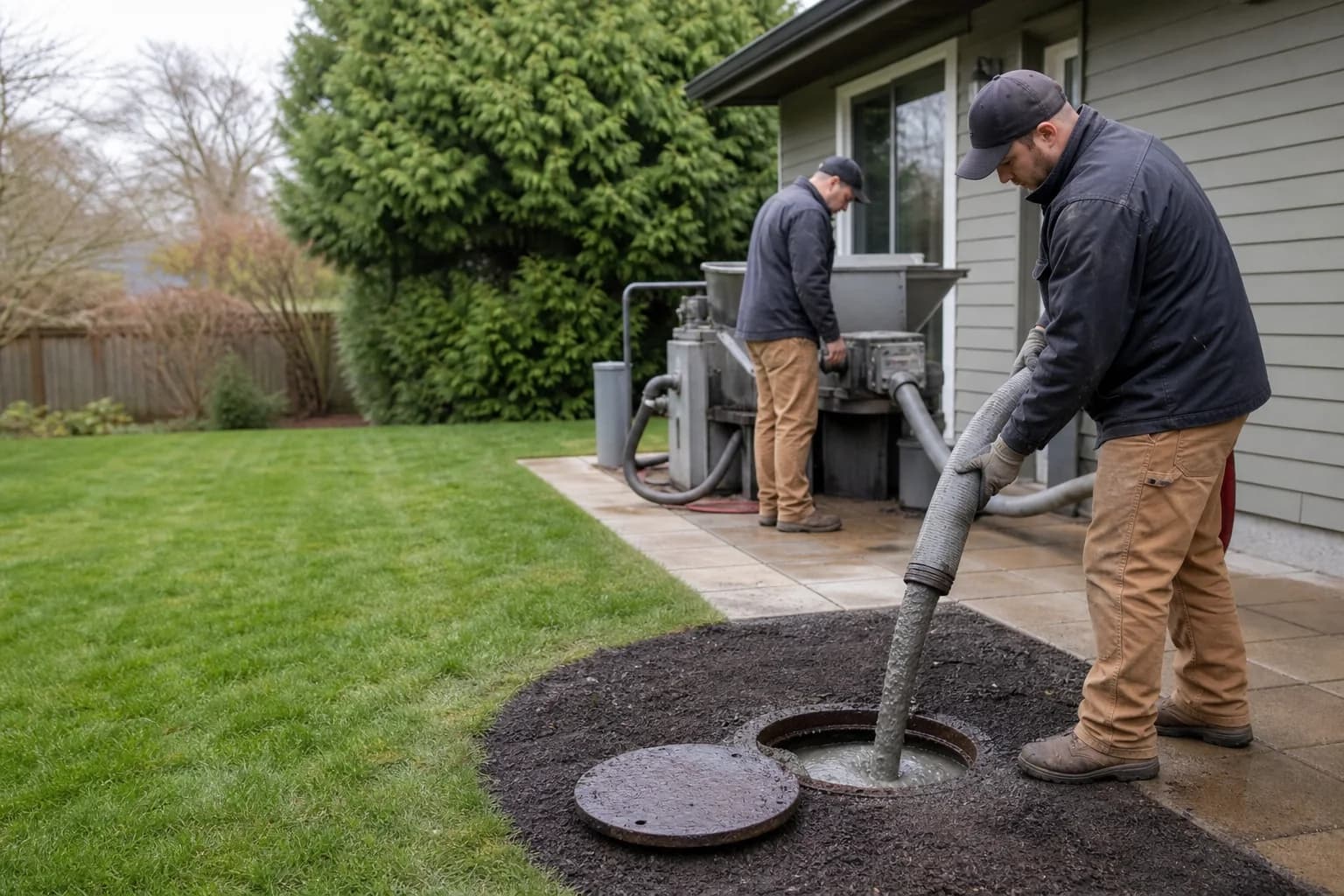
The provider pumps out any remaining oil and sludge, cleans the inside of the tank so it is no longer a source of product, and fills the empty shell with an inert material such as sand or a flowable slurry so the void cannot collapse later. Soil samples are taken from beneath and around the tank and analyzed by an accredited lab, and a Decommissioning Report goes to DEQ. The difference between the two paths is the excavation, not the paperwork or the testing.
- The tank is emptied of oil and residual sludge.
- The interior is cleaned so the tank is no longer a product source.
- The void is filled with sand or a controlled low-strength slurry.
- Soil samples are pulled and analyzed, and a DEQ Decommissioning Report is filed.
// Featured service
Underground Oil Tank Removal
Full decommissioning of buried heating oil tanks (USTs) in Salem under the Oregon DEQ HOT program. We locate, pump, cut, lift, and document, closing with a signed Decommissioning Report and lab-tested soil samples for the property file.
When you can leave the tank where it is
The in-place option is open to you when three things line up. The tank can be safely accessed and cleaned, the soil samples come back below DEQ’s cleanup levels, and nothing about your plans for the property requires the ground where the tank sits. On a typical older Salem lot with a side-yard tank and no sign of a leak, all three usually hold, and decommissioning in place is the straightforward, lower-cost route.
This is also the path that makes the most sense when the tank is hard to reach. A tank buried under a poured driveway, a garage slab, or a later addition is expensive to dig out, and if the soil under it is clean there is little practical reason to. Where it sits decides a lot, which is the same access question that shapes the wider abandon-or-remove decision for your property.
When Salem conditions force a full removal
The permission to leave a tank in place disappears the moment the soil tells a different story. If the samples show a release, that contaminated soil has to be addressed under DEQ’s cleanup expectations, and excavating it almost always means the tank comes out as part of the work. You cannot leave a leaking tank sitting in soil that needs to be dug up and hauled away. At that point the job is a cleanup, and the in-place plan is off the table.
Construction is the second trigger. If you are planning an addition, a new garage, a foundation, or any excavation over the tank’s footprint, the tank has to be removed before that work can proceed. The third trigger is not the regulator at all. A buyer, a lender, or an insurer can require a physical removal as a condition of the deal, and their requirement overrides the fact that DEQ would have let you leave it. On a Salem sale, that demand surfaces late and stalls escrow if you assumed the cheaper path was settled.
- Soil samples show contamination that has to be excavated.
- You are building over or beside the tank’s location.
- A buyer, lender, or insurer makes removal a condition of the sale or policy.
- The tank cannot be safely emptied, cleaned, and filled in place.
Access, soil, and the Willamette Valley factor
Local conditions tilt the decision in ways that are specific to this area. Marion and Polk County’s wet winters and heavy valley soil make in-place decommissioning attractive on tight lots, because a full excavation in saturated ground is messier, slower, and harder to restore cleanly. Many older homes around central Salem, Keizer, and West Salem have tanks crowded against a foundation or under hardscape, where leaving a clean tank in place avoids tearing up a driveway you would only have to rebuild.
Geography also decides which office signs off. Most of Salem and all of Keizer fall under the City of Salem and Marion County, while West Salem sits across the river in Polk County and permits through that county instead. The decommissioning standard does not change between them, but knowing which jurisdiction your address belongs to keeps the permit and the eventual Decommissioning Report consistent with the rest of your property file.
How to decide for your property
Work the question in order. Confirm the tank can be reached and cleaned, get the soil sampled, and only then weigh in-place against removal. If the samples are clean and you have no construction planned, decommissioning in place is usually the sensible, lower-cost choice, and the one DEQ readily accepts. If a release shows up, or a buyer or lender draws a line, treat removal as the path and plan for the larger scope and cost that comes with it.
The one mistake to avoid is committing to leaving the tank in the ground before the soil is tested or before you know what a future buyer will require. A clean in-place decommissioning is a perfectly good result in Salem, but it has to be earned with the testing and the documentation, not assumed because it is cheaper. Get the conditions confirmed first, and the right path usually picks itself.
Find out whether your Salem tank can be left in place, quoted up front
Speak to a Salem-area decommissioning crew. Free site survey.
Request a quoteFrequently asked questions
Is it legal to leave an oil tank buried in Salem?
Yes, in most cases. The Oregon DEQ Heating Oil Tank program allows a tank to be decommissioned in place rather than removed, provided a licensed service provider empties it, cleans it, fills the void with inert material, and the required soil samples come back clean. Done that way, leaving the tank in the ground is a compliant outcome, not a shortcut, and it closes the property’s regulatory file the same as a removal does.
When does my Salem tank have to come out instead?
Removal is effectively forced in three situations. If soil samples show a release, the contaminated soil has to be excavated and the tank usually comes out as part of that cleanup. If you are building over or near the tank’s footprint, it has to go before the work. And if your buyer, lender, or insurer insists on a physical removal, the regulator’s permission to leave it in place no longer settles the matter.
Do I still need soil testing if I leave the tank in the ground?
Yes. Decommissioning in place does not skip the soil sampling. A licensed provider still pulls samples from beneath and around the tank and has them analyzed by an ORELAP-accredited lab. The point of leaving the tank is to avoid the excavation, not to avoid proving the soil is clean. If those samples come back over the cleanup level, the in-place path is the one that gets interrupted.
Will a Salem buyer or lender accept a tank left in the ground?
Often, yes, when the decommissioning was done properly and you can hand over the DEQ Decommissioning Report and clean soil results. Many Salem buyers, including the state-employee and relocation households common here, read those records closely and accept a documented in-place decommissioning. Some lenders and insurers still prefer or require a full removal, so confirm their position before you assume the cheaper path will clear the sale.
Is leaving the tank in place cheaper than removing it?
Usually, because you avoid the excavation, the haul-off, and the site restoration. The gap is widest when the tank sits under a driveway, slab, or addition where digging is expensive. It narrows or disappears if contamination turns the job into a cleanup anyway. The cost comparison is its own subject, and the Salem cost guide breaks down what actually drives the two prices.